
IMAGES TAKEN NEAR TO
Leigham Court Road, LONDON, SW16 2NR
Introduction
This page details the photographs taken nearby to Leigham Court Road, SW16 2NR by members of the Geograph project.
The Geograph project started in 2005 with the aim of publishing, organising and preserving representative images for every square kilometre of Great Britain, Ireland and the Isle of Man.

There are currently over 7.5m images from over14,400 individuals and you can help contribute to the project by visiting https://www.geograph.org.uk
Image Map
Images are licensed for reuse under creativecommons.org/licenses/by-sa/2.0
Notes
- Clicking on the map will re-center to the selected point.
- The higher the marker number, the further away the image location is from the centre of the postcode.
Image Listing (100 Images Found)
Images are licensed for reuse under creativecommons.org/licenses/by-sa/2.0
Image
Details
Distance
1
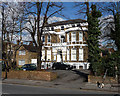
75 and 75a Leigham Court Road
Formerly known as Eastbury House, now divided into flats, this "serious double-fronted mansion built over four floors" dates from 1870 and is built of stock brick with stucco decoration. The arch and decorative panels make a good feature of the porch. The smaller building to the left is the original coach house (though with modern windows). There are several mature trees in the front garden. It is within the Leigham Court Road (North) Conservation Area.
Leigham Court Road was laid out in 1839, and while development began in the early 1840s, it didn’t really take off until after the building of the Crystal Palace and West End Railway and the opening of Streatham Hill station in 1856. Quite a number of the original, large Victorian houses survive at either end of the road, and even though their grounds have in some cases since been built on, the remaining mature trees and general landscaping have enabled the area to retain “much of its original arcadian character.” Information from Lambeth Council (http://www.lambeth.gov.uk/NR/exeres/CE4B5CE1-0387-40ED-B5A9-273A5160C34A.htm ).
Image: © Stephen Richards
Taken: Unknown
0.01 miles
2
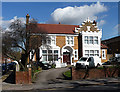
73 Leigham Court Road
A distinctive house of c1870. The main features are the crowstepped gable on the right and the decorative arched canopy above the front door. Also some Tudor windows with mullions and transoms, and a castellated parapet above the bay window. It is within the Leigham Court Road (North) Conservation Area.
Leigham Court Road was laid out in 1839, and while development began in the early 1840s, it didn’t really take off until after the building of the Crystal Palace and West End Railway and the opening of Streatham Hill station in 1856. Quite a number of the original, large Victorian houses survive at either end of the road, and even though their grounds have in some cases since been built on, the remaining mature trees and general landscaping have enabled the area to retain “much of its original arcadian character.” Information from Lambeth Council (http://www.lambeth.gov.uk/NR/exeres/CE4B5CE1-0387-40ED-B5A9-273A5160C34A.htm ).
Image: © Stephen Richards
Taken: Unknown
0.01 miles
3
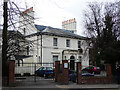
22 Leigham Court Road
Formerly known as Leigham Lodge and the home of Beriah Drew, Lord Mayor of Leigham, solicitor and developer of Leigham Court Road. It was built in 1843 and was the first house in the road. A fairly typical stucco villa of the period except for the prodigious chimneys. Grade II listed. It is within the Leigham Court Road (North) Conservation Area.
Leigham Court Road was laid out in 1839, and while development began in the early 1840s, it didn’t really take off until after the building of the Crystal Palace and West End Railway and the opening of Streatham Hill station in 1856. Quite a number of the original, large Victorian houses survive at either end of the road, and even though their grounds have in some cases since been built on, the remaining mature trees and general landscaping have enabled the area to retain “much of its original arcadian character.” Information from Lambeth Council (http://www.lambeth.gov.uk/NR/exeres/CE4B5CE1-0387-40ED-B5A9-273A5160C34A.htm ).
Image: © Stephen Richards
Taken: Unknown
0.06 miles
4
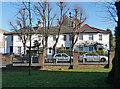
21, 23 and 25 Leigham Avenue
With their pitched roofs, sash windows and front gardens complete with lime trees, this pretty little group wouldn't look out of place by a village green in the home counties. Probably built in the 1930s. They are within the Leigham Court Road (North) Conservation Area. Information from Lambeth Council (http://www.lambeth.gov.uk/NR/exeres/CE4B5CE1-0387-40ED-B5A9-273A5160C34A.htm ).
Image: © Stephen Richards
Taken: Unknown
0.07 miles
5
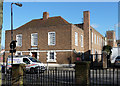
Telephone exchange, Leigham Avenue
Dated 1949. In the usual neo-Georgian style. The central chimney is tapered. The building is very long, occupying the former garden of 20 Leigham Court Road. It is within the Leigham Court Road (North) Conservation Area. Information from Lambeth Council (http://www.lambeth.gov.uk/NR/exeres/CE4B5CE1-0387-40ED-B5A9-273A5160C34A.htm ).
Image: © Stephen Richards
Taken: Unknown
0.08 miles
6
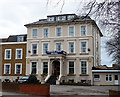
18 Leigham Court Road
A large four-square house whose first recorded occupant was John Southgate, a manufacturer and wholesaler, in 1876-88. The design is essentially Classical, but with the typical heavier Victorian details. The unfortunate dormer windows are late C20th. The house is currently a hotel. It is within the Leigham Court Road (North) Conservation Area.
Leigham Court Road was laid out in 1839, and while development began in the early 1840s, it didn’t really take off until after the building of the Crystal Palace and West End Railway and the opening of Streatham Hill station in 1856. Quite a number of the original, large Victorian houses survive at either end of the road, and even though their grounds have in some cases since been built on, the remaining mature trees and general landscaping have enabled the area to retain “much of its original arcadian character.” Information from Lambeth Council (http://www.lambeth.gov.uk/NR/exeres/CE4B5CE1-0387-40ED-B5A9-273A5160C34A.htm ).
Image: © Stephen Richards
Taken: Unknown
0.08 miles
7
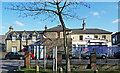
17 and 19 Leigham Avenue
The left-hand section, No. 17, with three gabled dormers was probably built as accommodation for domestic staff of 16 Leigham Court Road (Image]). Drainage records indicate there was a winery, pit frames, stove and greenhouse, potting shed, fowl house, greenhouses, and a peach house.
No. 19, on the right, is likely to originally have served the same purpose for 18 Leigham Court Road (Image]). It is currently a motor repair workshop.
Both are within the Leigham Court Road (North) Conservation Area. Information from Lambeth Council (http://www.lambeth.gov.uk/NR/exeres/CE4B5CE1-0387-40ED-B5A9-273A5160C34A.htm ).
Image: © Stephen Richards
Taken: Unknown
0.09 miles
8
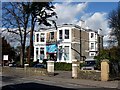
55 Leigham Court Road
Like many of its neighbours, dating from the 1860s. Of grey brick with two full-height canted bays. In 1903 it was the home of George Randall Higgins, a partner in a Peckham department store, Jones and Higgins. Now a school, it is within the Leigham Court Road (North) Conservation Area.
Leigham Court Road was laid out in 1839, and while development began in the early 1840s, it didn’t really take off until after the building of the Crystal Palace and West End Railway and the opening of Streatham Hill station in 1856. Quite a number of the original, large Victorian houses survive at either end of the road, and even though their grounds have in some cases since been built on, the remaining mature trees and general landscaping have enabled the area to retain “much of its original arcadian character.” Information from Lambeth Council (http://www.lambeth.gov.uk/NR/exeres/CE4B5CE1-0387-40ED-B5A9-273A5160C34A.htm ).
Image: © Stephen Richards
Taken: Unknown
0.09 miles
9
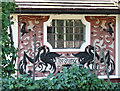
Detail of gatehouse, 76 Leigham Court Road
A close-up of the pargetting on the side of the gatehouse. It is fancifully decorated with masks, mythical birds and scrolls, and the date 1900 just can be discerned. A view of the main house can be found here: Image
Image: © Stephen Richards
Taken: Unknown
0.09 miles
10
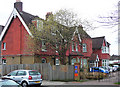
76 Leigham Court Road
The Grange is an Arts and Craft style house, with extensive tile-hanging and bargeboards. The date 1900 is recorded in a plaque on the decorative gatehouse (Image]). The house is currently a medical clinic. It is within the Leigham Court Road (North) Conservation Area.
Leigham Court Road was laid out in 1839, and while development began in the early 1840s, it didn’t really take off until after the building of the Crystal Palace and West End Railway and the opening of Streatham Hill station in 1856. Quite a number of the original, large Victorian houses survive at either end of the road, and even though their grounds have in some cases since been built on, the remaining mature trees and general landscaping have enabled the area to retain “much of its original arcadian character.” Information from Lambeth Council (http://www.lambeth.gov.uk/NR/exeres/CE4B5CE1-0387-40ED-B5A9-273A5160C34A.htm ).
Image: © Stephen Richards
Taken: Unknown
0.10 miles