
IMAGES TAKEN NEAR TO
Kings Court, Chapel Street, KING'S LYNN, PE30 9TD
Introduction
This page details the photographs taken nearby to Kings Court, Chapel Street, PE30 9TD by members of the Geograph project.
The Geograph project started in 2005 with the aim of publishing, organising and preserving representative images for every square kilometre of Great Britain, Ireland and the Isle of Man.

There are currently over 7.5m images from over14,400 individuals and you can help contribute to the project by visiting https://www.geograph.org.uk
Image Map
Images are licensed for reuse under creativecommons.org/licenses/by-sa/2.0
Notes
- Clicking on the map will re-center to the selected point.
- The higher the marker number, the further away the image location is from the centre of the postcode.
Image Listing (798 Images Found)
Images are licensed for reuse under creativecommons.org/licenses/by-sa/2.0
Image
Details
Distance
1
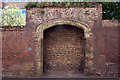
North gateway into precinct of Austin friars, Austin Street, King's Lynn
Grade II Listed 15th century gateway. Property in Lynn was granted to the Austin friars in 1293 by Margaret de Southmere. The only surviving remains of Augustinian Friary that occupied the site from 1293 to 1539. Prior John Capgrave (1393-1464) was an early historian who lived here. Kings Henry V, VI and VII stayed here. After the Dissolution, John Eyre purchased it from the King in 1544.
Image: © Jo and Steve Turner
Taken: 10 Jun 2017
0.01 miles
3
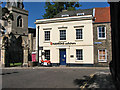
Hawkins Solicitors in Chapel Street, Kings Lynn
St Nicholas' chapel adjoins in the west.
Image: © Evelyn Simak
Taken: 17 Jun 2010
0.02 miles
4
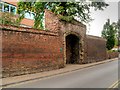
Austin Friars Gateway
The gateway to the Augustinian friary which occupied the site beyond the wall from 1293 to 1539. It is grade II listed (English Heritage Building ID: 384069 http://www.britishlistedbuildings.co.uk/en-384069-north-gateway-to-friary-precinct-norfolk#.Vdno93mFOHs British Listed Buildings).
Image: © David Dixon
Taken: 5 Aug 2015
0.02 miles
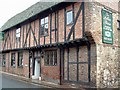
6
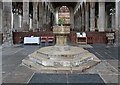
St Nicholas, King's Lynn, Norfolk - Font
Image: © John Salmon
Taken: 11 Jun 2010
0.03 miles
7
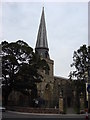
St Nicholas's Chapel
St Nicholas's Chapel was constructed around 1200 during the expansion of Lynn by Bishop William Turbus - the third Bishop of Norwich. The expansion saw not only the construction of the chapel, but also the Tuesday Market Place - which is still the primary marketplace in the town today. Consequently, the chapel quickly became Lynn's second church by a comfortable margin. It was not long before it was so popular that it launched pleas to become independent from St Margaret's Church; in 1426 St Nicholas's Chapel had congregations of 1,400 - compared to 1,600 at St Margaret's. Despite this, it took until 1627 before the chapel obtained baptismal rights.
Due to the rise in popularity, and the fact that the north of Lynn became quite affluent the chapel was rebuilt between 1380 and 1410 on a much larger scale in the grand perpendicular scale of the time.
The church is England's largest chapel of ease, a chapel dependent on a church and serving part of the parish for the convenience of parishioneres nearby. It is worth visiting not only for the building itself, but also for the human stories it tells.
The church is most distinctive for its tall spire, although it is not the original. There were at least two spires previously - one of which was destroyed in the storm of 1741 (along with the spire and lantern of St Margaret's), and another which stood from 1749 to 1854 described as 'never a regular spire but a kind of wooden extinguisher stuck on to be seen at sea'.
Image: © Oxyman
Taken: 2 Aug 2007
0.03 miles
8
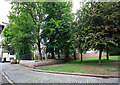
Towards St Nicholas, King's Lynn, Norfolk
Image: © John Salmon
Taken: 11 Jun 2010
0.03 miles
9
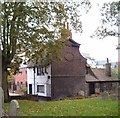
Exorcist's House
'Built in 1635 with a fine example of a Dutch gable on the north side.
Known as the Exorcist's House because of an earlier house on the site occupied by that member of the St Nicholas clergy.'
Quoted from a plaque on the side of the house.
Exorcist House is located in Chapel Street just a few yards from St Nicholas' Chapel.
Image: © Martin Pearman
Taken: 7 Nov 2006
0.03 miles
10
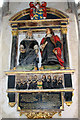
St Nicholas' Chapel in Kings Lynn - C17 monument
Commemorating Thomas and Susanna Greene, 1675, believed to be by the Lynn architect Henry Bell.
Image: © Evelyn Simak
Taken: 2 Jul 2010
0.03 miles