
IMAGES TAKEN NEAR TO
Out Risbygate, BURY ST. EDMUNDS, IP33 3RL
Introduction
This page details the photographs taken nearby to Out Risbygate, IP33 3RL by members of the Geograph project.
The Geograph project started in 2005 with the aim of publishing, organising and preserving representative images for every square kilometre of Great Britain, Ireland and the Isle of Man.

There are currently over 7.5m images from over14,400 individuals and you can help contribute to the project by visiting https://www.geograph.org.uk
Image Map
Images are licensed for reuse under creativecommons.org/licenses/by-sa/2.0
Notes
- Clicking on the map will re-center to the selected point.
- The higher the marker number, the further away the image location is from the centre of the postcode.
Image Listing (109 Images Found)
Images are licensed for reuse under creativecommons.org/licenses/by-sa/2.0
Image
Details
Distance
1
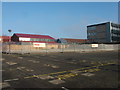
Building gone, West Suffolk College
The builders' fence marks the area where a building used to be - it was called Rendezvous and I think it was a kind of youth club. This change is obviously a part of the same project that has put a new facade on the main building, just visible on the right.
Image: © John Goldsmith
Taken: 20 Nov 2011
0.00 miles
2
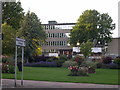
West Suffolk College from across the street
It was recently announced that the college would like to demolish these 1960s buildings and rebuild, as they are so old that they are no longer fit for purpose. What does that say about the many establishments operating from Victorian buildings, and even more so the colleges in Cambridge and Oxford?
The building has now vanished behind a wall of scaffolding and netting.
The College certainly does its part to support Bury in Bloom.
The large stone near the planter is the so-called plague stone. This appears to be a part of a looted pillar from the abbey and was reputedly used as a wash basin for travellers' coins during the Black Death.
This view is the reverse of Image
Image: © John Goldsmith
Taken: 21 Jun 2011
0.03 miles
3
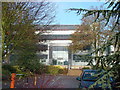
West Suffolk College unveils new look
The main building at West Suffolk College has been under wraps for many weeks, and they have now been removed to reveal a new look. Battleship grey is not the most obvious colour to choose but it seems to work.
Compare this with Image
Image: © John Goldsmith
Taken: 20 Nov 2011
0.03 miles
4
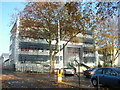
New facade on West Suffolk College
Recently revealed. You can see that it only wraps a small distance around the corners of the 1960s building.
Image: © John Goldsmith
Taken: 20 Nov 2011
0.03 miles
5
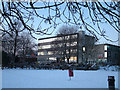
Sunset reflects off West Suffolk College
The windows of the main building of West Suffolk College reflect a sunset sky, in a snowy scene. The college site is split in two by the tall wall visible to the left, a legacy of the barracks formerly on part of the site.
Image: © John Goldsmith
Taken: 8 Jan 2010
0.04 miles
6
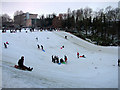
Sledging at St. Peter's Pit
This is the favourite sledging spot for Bury St. Edmunds - one of the few steep slopes with public access. St. Peter's pit is basically rectangular, but a fenced off private site occupies one side, and another side is lightly wooded. Despite the use of two routes at right angles there are few collisions. The fence acts as a final stop, and depending on footwear can provide a necessary help on the return climb.
As well as plastic, wooden and metal runner sledges, improvised versions included carpet squares, plastic bags (including one girl wearing one like a short skirt), a tarpaulin with 7 riders, a blow-up jetski, crates fixed to real skis, skateboards with wheels removed, surf boards, and the rather unsuccessful bread tray visible here (It's the wrong way round you idiot).
What a brilliant way for children to get serious exercise and to very clearly enjoy it. And a great way to socialise.
Houses in Grove Park and the West Suffolk College can be seen behind.
Image: © John Goldsmith
Taken: 8 Jan 2010
0.05 miles
7
![Bury St Edmunds buildings [245]](https://s3.geograph.org.uk/geophotos/06/69/90/6699051_18483f2c_120x120.jpg)
Bury St Edmunds buildings [245]
Part of the outer walls of Gibraltar Barracks with the top of the keep visible. The high walls are in red brick, divided into bays by pilasters, on a high plinth and with a projecting top with rounded copings.
The keep and the walls are the remaining parts of a much larger depot complex
built in 1878 as part of the army's 'localisation' process which was intended to improve the ties between a regiment and its locality to assist recruitment. The keep raised the local profile of the barracks, and provided a focus for the regiment. The depot ceased to be used in 1960 and is now The Suffolk Regimental Museum. Listed, grade II with details of the keep at: https://historicengland.org.uk/listing/the-list/list-entry/1244805 and details of the walls at: https://historicengland.org.uk/listing/the-list/list-entry/1244844
Brentgovel Street and Risbygate Street was a prosperous area in the fifteenth century but it became neglected and decay had set in. In the 1990s, a Conservation Area Partnership Schemes was introduced to give a new lease of life into the area by repairing and reusing historic buildings. Forty-five new residential units and ten new retail units have resulted in the area thriving again.
Bury St Edmunds is a market town which is the cultural and retail centre for West Suffolk and is known for brewing (Greene King) and sugar (British Sugar). There is scattered evidence of earlier activity but essentially Bury St Edmunds began as one of the royal boroughs of the Saxons and a monastery was founded which became the burial place of King Edmund. A new Benedictine abbey was built in 1020 which became rich and powerful and the town was laid out on a grid pattern by Abbot Baldwin. After the dissolution the abbey became ruinous. A new church, later the cathedral, was begun in the early 16th century.
Image: © Michael Dibb
Taken: 11 Sep 2020
0.05 miles
8
![Bury St Edmunds buildings [246]](https://s1.geograph.org.uk/geophotos/06/69/90/6699053_20ec6fe4_120x120.jpg)
Bury St Edmunds buildings [246]
The keep of Gibraltar Barracks built in red brick with white brick and ashlar dressings. The walls are topped by a high crenellated parapet. The towers, which contain the stairs, have a row of three narrow stepped windows to each storey and the projecting top is crenellated above a row of stone machicolations.
The keep and the walls are the remaining parts of a much larger depot complex
built in 1878 as part of the army's 'localisation' process which was intended to improve the ties between a regiment and its locality to assist recruitment. The keep raised the local profile of the barracks, and provided a focus for the regiment. The depot ceased to be used in 1960 and is now The Suffolk Regimental Museum. Listed, grade II with details of the keep at: https://historicengland.org.uk/listing/the-list/list-entry/1244805 and details of the walls at: https://historicengland.org.uk/listing/the-list/list-entry/1244844
Brentgovel Street and Risbygate Street was a prosperous area in the fifteenth century but it became neglected and decay had set in. In the 1990s, a Conservation Area Partnership Schemes was introduced to give a new lease of life into the area by repairing and reusing historic buildings. Forty-five new residential units and ten new retail units have resulted in the area thriving again.
Bury St Edmunds is a market town which is the cultural and retail centre for West Suffolk and is known for brewing (Greene King) and sugar (British Sugar). There is scattered evidence of earlier activity but essentially Bury St Edmunds began as one of the royal boroughs of the Saxons and a monastery was founded which became the burial place of King Edmund. A new Benedictine abbey was built in 1020 which became rich and powerful and the town was laid out on a grid pattern by Abbot Baldwin. After the dissolution the abbey became ruinous. A new church, later the cathedral, was begun in the early 16th century.
Image: © Michael Dibb
Taken: 11 Sep 2020
0.05 miles
9
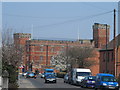
Royal Anglian Regiment Headquarters, Bury St. Edmunds
Image: © Bikeboy
Taken: 10 Apr 2013
0.05 miles
10
![Bury St Edmunds buildings [247]](https://s2.geograph.org.uk/geophotos/06/69/90/6699054_494b22f0_120x120.jpg)
Bury St Edmunds buildings [247]
Part of the outer walls of Gibraltar Barracks. The high walls are in red brick, divided into bays by pilasters, on a high plinth and with a projecting top with rounded copings.
The keep and the walls are the remaining parts of a much larger depot complex
built in 1878 as part of the army's 'localisation' process which was intended to improve the ties between a regiment and its locality to assist recruitment. The keep raised the local profile of the barracks, and provided a focus for the regiment. The depot ceased to be used in 1960 and is now The Suffolk Regimental Museum. Listed, grade II with details of the keep at: https://historicengland.org.uk/listing/the-list/list-entry/1244805 and details of the walls at: https://historicengland.org.uk/listing/the-list/list-entry/1244844
Brentgovel Street and Risbygate Street was a prosperous area in the fifteenth century but it became neglected and decay had set in. In the 1990s, a Conservation Area Partnership Schemes was introduced to give a new lease of life into the area by repairing and reusing historic buildings. Forty-five new residential units and ten new retail units have resulted in the area thriving again.
Bury St Edmunds is a market town which is the cultural and retail centre for West Suffolk and is known for brewing (Greene King) and sugar (British Sugar). There is scattered evidence of earlier activity but essentially Bury St Edmunds began as one of the royal boroughs of the Saxons and a monastery was founded which became the burial place of King Edmund. A new Benedictine abbey was built in 1020 which became rich and powerful and the town was laid out on a grid pattern by Abbot Baldwin. After the dissolution the abbey became ruinous. A new church, later the cathedral, was begun in the early 16th century.
Image: © Michael Dibb
Taken: 11 Sep 2020
0.05 miles