
IMAGES TAKEN NEAR TO
Guildhall Street, BURY ST. EDMUNDS, IP33 1QB
Introduction
This page details the photographs taken nearby to Guildhall Street, IP33 1QB by members of the Geograph project.
The Geograph project started in 2005 with the aim of publishing, organising and preserving representative images for every square kilometre of Great Britain, Ireland and the Isle of Man.

There are currently over 7.5m images from over14,400 individuals and you can help contribute to the project by visiting https://www.geograph.org.uk
Image Map
Images are licensed for reuse under creativecommons.org/licenses/by-sa/2.0
Notes
- Clicking on the map will re-center to the selected point.
- The higher the marker number, the further away the image location is from the centre of the postcode.
Image Listing (1793 Images Found)
Images are licensed for reuse under creativecommons.org/licenses/by-sa/2.0
Image
Details
Distance
1
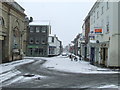
Guildhall Street in the snow
Looking south first along Cornhill and then from the no entry sign is Guildhall Street Bury St.Edmunds Suffolk.
Image: © Keith Evans
Taken: 23 Mar 2008
0.01 miles
2
![Bury St Edmunds buildings [79]](https://s0.geograph.org.uk/geophotos/06/66/25/6662536_967237a1_120x120.jpg)
Bury St Edmunds buildings [79]
Now offices, this large house dates from the early and late 18th century in red brick with an extension at the south end in white brick with a blocked doorway. A thick wall running through part of the building is 12th century. There are several 20th century extensions. Many original 18th century fittings remain, including a stair which rises the full height of the building. Listed, grade II*, with details at: https://historicengland.org.uk/listing/the-list/list-entry/1363717
Guildhall Street is one of the north-south streets laid out in the 12th century. There is a rich mix of high quality buildings, especially at the commercial, northern end with a fine mix of houses at the residential, southern end. The Guildhall is a Norman building which is the oldest continuously used Civic building in the country.
Bury St Edmunds is a market town which is the cultural and retail centre for West Suffolk and is known for brewing (Greene King) and sugar (British Sugar). There is scattered evidence of earlier activity but essentially Bury St Edmunds began as one of the royal boroughs of the Saxons and a monastery was founded which became the burial place of King Edmund. A new Benedictine abbey was built in 1020 which became rich and powerful and the town was laid out on a grid pattern by Abbot Baldwin. After the dissolution the abbey became ruinous. A new church, later the cathedral, was begun in the early 16th century.
Image: © Michael Dibb
Taken: 13 Sep 2020
0.01 miles
3
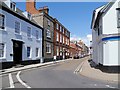
Bury St Edmunds, Guildhall Street
The corner of Churchgate Street and Guildhall Street in Bury St Edmunds.
Image: © David Dixon
Taken: 3 Aug 2013
0.01 miles
4
![Bury St Edmunds houses [59]](https://s2.geograph.org.uk/geophotos/06/65/91/6659146_d4d8025f_120x120.jpg)
Bury St Edmunds houses [59]
Number 14 Guildhall Street is a house of two halves. The northern part (nearest the camera) is 16th century timber framed and roughcast to the front with the side wall rebuilt in red brick. The second storey is 19th century, added when the southern part of the house was built. Listed, grade II, with details at: https://historicengland.org.uk/listing/the-list/list-entry/1363698
Guildhall Street is one of the north-south streets laid out in the 12th century. There is a rich mix of high quality buildings, especially at the commercial, northern end with a fine mix of houses at the residential, southern end. The Guildhall is a Norman building which is the oldest continuously used Civic building in the country.
Bury St Edmunds is a market town which is the cultural and retail centre for West Suffolk and is known for brewing (Greene King) and sugar (British Sugar). There is scattered evidence of earlier activity but essentially Bury St Edmunds began as one of the royal boroughs of the Saxons and a monastery was founded which became the burial place of King Edmund. A new Benedictine abbey was built in 1020 which became rich and powerful and the town was laid out on a grid pattern by Abbot Baldwin. After the dissolution the abbey became ruinous. A new church, later the cathedral, was begun in the early 16th century.
Image: © Michael Dibb
Taken: 13 Sep 2020
0.01 miles
5
![Bury St Edmunds buildings [74]](https://s0.geograph.org.uk/geophotos/06/65/91/6659140_a8451076_120x120.jpg)
Bury St Edmunds buildings [74]
The magnificent Guildhall is believed to have been part of the medieval ‘planned’ town that was begun in the late eleventh century and the existing building was constructed in the second half of the twelfth century. There were major improvements and additions in the late fifteenth century when the decorative porch was added and the King and Queen post roof was constructed. At the same time a new range of buildings were added to the rear as was a detached kitchen. The building was faced in white brick in 1807. The rear kitchen was rebuilt in the mid 19th century. Listed, grade I, with details at: https://historicengland.org.uk/listing/the-list/list-entry/1363726
Guildhall Street is one of the north-south streets laid out in the 12th century. There is a rich mix of high quality buildings, especially at the commercial, northern end with a fine mix of houses at the residential, southern end. The Guildhall is a Norman building which is the oldest continuously used Civic building in the country.
Bury St Edmunds is a market town which is the cultural and retail centre for West Suffolk and is known for brewing (Greene King) and sugar (British Sugar). There is scattered evidence of earlier activity but essentially Bury St Edmunds began as one of the royal boroughs of the Saxons and a monastery was founded which became the burial place of King Edmund. A new Benedictine abbey was built in 1020 which became rich and powerful and the town was laid out on a grid pattern by Abbot Baldwin. After the dissolution the abbey became ruinous. A new church, later the cathedral, was begun in the early 16th century.
Image: © Michael Dibb
Taken: 13 Sep 2020
0.01 miles
6
![Bury St Edmunds buildings [80]](https://s2.geograph.org.uk/geophotos/06/66/25/6662562_d932dcb5_120x120.jpg)
Bury St Edmunds buildings [80]
This magnificent house, 81 and 82 Guildhall Street was used as offices for decades and was recently sold for possible re-conversion to a single dwelling. The mid 18th century central range was extended in the late 18th century with pedimented wings to each side. The wings were designed by the world-renowned architect John Soane. One wing was designed as a counting-house with a dining parlour for customers above and it became the premises of Bury & Suffolk Bank. To the rear is a 19th century building originally part of a yarn warehouse now converted to offices. The interior has some fine late 18th and early 19th century features. Listed, grade I, with details at: https://historicengland.org.uk/listing/the-list/list-entry/1363718
Guildhall Street is one of the north-south streets laid out in the 12th century. There is a rich mix of high quality buildings, especially at the commercial, northern end with a fine mix of houses at the residential, southern end. The Guildhall is a Norman building which is the oldest continuously used Civic building in the country.
Bury St Edmunds is a market town which is the cultural and retail centre for West Suffolk and is known for brewing (Greene King) and sugar (British Sugar). There is scattered evidence of earlier activity but essentially Bury St Edmunds began as one of the royal boroughs of the Saxons and a monastery was founded which became the burial place of King Edmund. A new Benedictine abbey was built in 1020 which became rich and powerful and the town was laid out on a grid pattern by Abbot Baldwin. After the dissolution the abbey became ruinous. A new church, later the cathedral, was begun in the early 16th century.
Image: © Michael Dibb
Taken: 13 Sep 2020
0.02 miles
7
![Bury St Edmunds buildings [55]](https://s1.geograph.org.uk/geophotos/06/65/51/6655149_c7e32e24_120x120.jpg)
Bury St Edmunds buildings [55]
On the corner with Guildhall Street, numbers 1 and 1A Churchgate Street are now a shop and office. Formerly a house and shop, built in the late 15th or early 16th century and altered later. Timber framed and stuccoed, the gable facing Churchgate Street was possibly the medieval cross wing of a hall house. There would have been a shop front under the cornice above the ground floor. Listed, grade II, with details at: https://historicengland.org.uk/listing/the-list/list-entry/1248049
Churchgate Street is aligned with the Norman Tower entrance to the Abbey and would have been the ceremonial route between the Abbey and the Guildhall, the spiritual and the temporal. The street has some of the town’s most important historic buildings with structures dating back to the 13th century.
Bury St Edmunds is a market town which is the cultural and retail centre for West Suffolk and is known for brewing (Greene King) and sugar (British Sugar). There is scattered evidence of earlier activity but essentially Bury St Edmunds began as one of the royal boroughs of the Saxons and a monastery was founded which became the burial place of King Edmund. A new Benedictine abbey was built in 1020 which became rich and powerful and the town was laid out on a grid pattern by Abbot Baldwin. After the dissolution the abbey became ruinous. A new church, later the cathedral, was begun in the early 16th century.
Image: © Michael Dibb
Taken: 13 Sep 2020
0.02 miles
8
![Bury St Edmunds houses [41]](https://s3.geograph.org.uk/geophotos/06/65/51/6655155_c319e98e_120x120.jpg)
Bury St Edmunds houses [41]
The house at number 2 Churchgate Street formerly had a shop. Built in white brick in the early 19th century and the shop front is of the same date. Listed, grade II, with details at: https://historicengland.org.uk/listing/the-list/list-entry/1248050
Churchgate Street is aligned with the Norman Tower entrance to the Abbey and would have been the ceremonial route between the Abbey and the Guildhall, the spiritual and the temporal. The street has some of the town’s most important historic buildings with structures dating back to the 13th century.
Bury St Edmunds is a market town which is the cultural and retail centre for West Suffolk and is known for brewing (Greene King) and sugar (British Sugar). There is scattered evidence of earlier activity but essentially Bury St Edmunds began as one of the royal boroughs of the Saxons and a monastery was founded which became the burial place of King Edmund. A new Benedictine abbey was built in 1020 which became rich and powerful and the town was laid out on a grid pattern by Abbot Baldwin. After the dissolution the abbey became ruinous. A new church, later the cathedral, was begun in the early 16th century.
Image: © Michael Dibb
Taken: 13 Sep 2020
0.02 miles
9
![Bury St Edmunds houses [91]](https://s0.geograph.org.uk/geophotos/06/66/25/6662528_baf31638_120x120.jpg)
Bury St Edmunds houses [91]
Originally one house, now divided into two, numbers 78 and 78A Guildhall Street contain flats. Timber framed, jettied along the street and stuccoed. Number 78A has one room on each floor and a 20th century extension which probably replaced an earlier structure. Listed, grade II, with details at: https://historicengland.org.uk/listing/the-list/list-entry/1363715
Guildhall Street is one of the north-south streets laid out in the 12th century. There is a rich mix of high quality buildings, especially at the commercial, northern end with a fine mix of houses at the residential, southern end. The Guildhall is a Norman building which is the oldest continuously used Civic building in the country.
Bury St Edmunds is a market town which is the cultural and retail centre for West Suffolk and is known for brewing (Greene King) and sugar (British Sugar). There is scattered evidence of earlier activity but essentially Bury St Edmunds began as one of the royal boroughs of the Saxons and a monastery was founded which became the burial place of King Edmund. A new Benedictine abbey was built in 1020 which became rich and powerful and the town was laid out on a grid pattern by Abbot Baldwin. After the dissolution the abbey became ruinous. A new church, later the cathedral, was begun in the early 16th century.
Image: © Michael Dibb
Taken: 13 Sep 2020
0.02 miles
10
![Bury St Edmunds houses [92]](https://s3.geograph.org.uk/geophotos/06/66/25/6662531_a7a347f2_120x120.jpg)
Bury St Edmunds houses [92]
This large house at number 79 Guildhall Street is now offices and flats. A thick wall within the ground floor of the building is 12th century but mainly the building is 15th or 16th century. Timber framed and stuccoed with an 18th century front. There is a 17th century rear wing. Listed, grade II*, with details at: https://historicengland.org.uk/listing/the-list/list-entry/1363716
Guildhall Street is one of the north-south streets laid out in the 12th century. There is a rich mix of high quality buildings, especially at the commercial, northern end with a fine mix of houses at the residential, southern end. The Guildhall is a Norman building which is the oldest continuously used Civic building in the country.
Bury St Edmunds is a market town which is the cultural and retail centre for West Suffolk and is known for brewing (Greene King) and sugar (British Sugar). There is scattered evidence of earlier activity but essentially Bury St Edmunds began as one of the royal boroughs of the Saxons and a monastery was founded which became the burial place of King Edmund. A new Benedictine abbey was built in 1020 which became rich and powerful and the town was laid out on a grid pattern by Abbot Baldwin. After the dissolution the abbey became ruinous. A new church, later the cathedral, was begun in the early 16th century.
Image: © Michael Dibb
Taken: 13 Sep 2020
0.02 miles