
IMAGES TAKEN NEAR TO
The Street, WOODBRIDGE, IP13 0EF
Introduction
This page details the photographs taken nearby to The Street, IP13 0EF by members of the Geograph project.
The Geograph project started in 2005 with the aim of publishing, organising and preserving representative images for every square kilometre of Great Britain, Ireland and the Isle of Man.

There are currently over 7.5m images from over14,400 individuals and you can help contribute to the project by visiting https://www.geograph.org.uk
Image Map
Images are licensed for reuse under creativecommons.org/licenses/by-sa/2.0
Notes
- Clicking on the map will re-center to the selected point.
- The higher the marker number, the further away the image location is from the centre of the postcode.
Image Listing (115 Images Found)
Images are licensed for reuse under creativecommons.org/licenses/by-sa/2.0
Image
Details
Distance
1
The Street, Easton
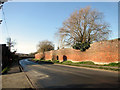
The village is mentioned in the Domesday Book and was linked to the manor of Martley until 1627, when Sir Arthur Wingfield made the 150 acre estate his home. In 1688 Easton was purchased by the Prince of Orange for the Earl of Rochford. The fifth Earl made many improvements before he died in 1830. These included surrounding the Easton Estate and house with its famous crinkle-crankle wall which is believed to be the longest example of this form of wall construction and design. When Easton Hall, the seat of the Duke and Duchess of Hamilton, was demolished and transported to the USA in the 1920s, to be re-assembled as a ranch, the estate's crinkle crankle boundary wall running alongside the road to All Saints Church remained as a fragmentary remnant of the previous estate.
The term ‘crinkle crankle' is, in origin, a Suffolk dialect term to describe substantial brick walls which are serpentine, or sinuously curving, in form. Sometimes they are known as ‘ribbon walls'. In their most traditional form they were built as a single line of bricks, with the sinuous design removing the need for buttressing, because the serpentine shape provided its own stability.
In the popular mind, crinkle crankle walls are especially associated with Suffolk. http://www.history.org.uk/resources/general_resource_2534_74.html
Image: © Evelyn Simak
Taken: 16 Jan 2012
0.03 miles
2
Easton's famous 'crinkley' wall
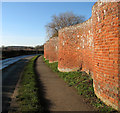
The village is mentioned in the Domesday Book and was linked to the manor of Martley until 1627, when Sir Arthur Wingfield made the 150 acre estate his home. In 1688 Easton was purchased by the Prince of Orange for the Earl of Rochford. The fifth Earl made many improvements before he died in 1830. These included surrounding the Easton Estate and house with its famous crinkle-crankle wall which is believed to be the longest example of this form of wall construction and design. When Easton Hall, the seat of the Duke and Duchess of Hamilton, was demolished and transported to the USA in the 1920s, to be re-assembled as a ranch, the estate's crinkle crankle boundary wall running alongside the road to All Saints Church remained as a fragmentary remnant of the previous estate.
The term ‘crinkle crankle' is, in origin, a Suffolk dialect term to describe substantial brick walls which are serpentine, or sinuously curving, in form. Sometimes they are known as ‘ribbon walls'. In their most traditional form they were built as a single line of bricks, with the sinuous design removing the need for buttressing, because the serpentine shape provided its own stability.
In the popular mind, crinkle crankle walls are especially associated with Suffolk. http://www.history.org.uk/resources/general_resource_2534_74.html
Image: © Evelyn Simak
Taken: 16 Jan 2012
0.03 miles
3

Crinkle Crankle Wall in Easton
https://historicengland.org.uk/listing/the-list/list-entry/1377276?section=official-list-entry
Image: © Sandy Gerrard
Taken: 26 Apr 2025
0.03 miles
4
The crinkle-crankle wall of Easton
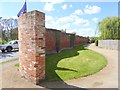
A wavy wall marks the boundary of the former Easton Hall estate along the Street in Easton. This form of construction makes for a stronger - and possibly more economical - wall than one which is straight. Judging from the EU flag it seems probable that someone in the locality is not very happy about Brexit.
Image: © Oliver Dixon
Taken: 25 Apr 2017
0.03 miles
5
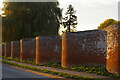
Crinkle-crankle wall down the south side of Easton Park
Image: © Christopher Hilton
Taken: 24 Oct 2021
0.03 miles
6
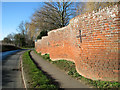
Tie beams in crinkle-crankle wall, Easton
The village is mentioned in the Domesday Book and was linked to the manor of Martley until 1627, when Sir Arthur Wingfield made the 150 acre estate his home. In 1688 Easton was purchased by the Prince of Orange for the Earl of Rochford. The fifth Earl made many improvements before he died in 1830. These included surrounding the Easton Estate and house with its famous crinkle-crankle wall which is believed to be the longest example of this form of wall construction and design. When Easton Hall, the seat of the Duke and Duchess of Hamilton, was demolished and transported to the USA in the 1920s, to be re-assembled as a ranch, the estate's crinkle crankle boundary wall running alongside the road to All Saints Church remained as a fragmentary remnant of the previous estate.
The term ‘crinkle crankle' is, in origin, a Suffolk dialect term to describe substantial brick walls which are serpentine, or sinuously curving, in form. Sometimes they are known as ‘ribbon walls'. In their most traditional form they were built as a single line of bricks, with the sinuous design removing the need for buttressing, because the serpentine shape provided its own stability.
In the popular mind, crinkle crankle walls are especially associated with Suffolk. http://www.history.org.uk/resources/general_resource_2534_74.html
Image: © Evelyn Simak
Taken: 16 Jan 2012
0.04 miles
7
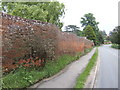
Crinkle-crankle wall 1
The squire of Easton Park did not want a straight wall around part of his property!
Image: © Jonathan Billinger
Taken: 30 May 2007
0.04 miles
8
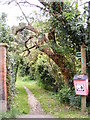
Footpath to Letheringham Mill
Off The Street, Easton
Image: © Geographer
Taken: 8 Sep 2011
0.04 miles
10
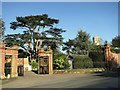
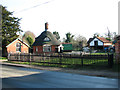
Original entrance gates to Easton Manor house, Easton
The village is mentioned in the Domesday Book and was linked to the manor of Martley until 1627, when Sir Anthony Wingfield made the 150 acre estate his home. In 1688 Easton was purchased by the Prince of Orange for the Earl of Rochford. The 5th Earl made many improvements before he died in 1830. These included surrounding the Easton Estate and house with its famous crinkle-crankle wall which is believed to be the longest example of this form of wall construction and design. When Easton Hall, the seat of the Duke and Duchess of Hamilton, was demolished and transported to the USA in the 1920s, to be re-assembled as a ranch, the estate's crinkle crankle boundary wall running alongside the road to All Saints Church remained as a fragmentary remnant of the previous estate.
Image: © Evelyn Simak
Taken: 16 Jan 2012
0.07 miles