
IMAGES TAKEN NEAR TO
Kirk Wynd, CLACKMANNAN, FK10 4JF
Introduction
This page details the photographs taken nearby to Kirk Wynd, FK10 4JF by members of the Geograph project.
The Geograph project started in 2005 with the aim of publishing, organising and preserving representative images for every square kilometre of Great Britain, Ireland and the Isle of Man.

There are currently over 7.5m images from over14,400 individuals and you can help contribute to the project by visiting https://www.geograph.org.uk
Image Map
Images are licensed for reuse under creativecommons.org/licenses/by-sa/2.0
Notes
- Clicking on the map will re-center to the selected point.
- The higher the marker number, the further away the image location is from the centre of the postcode.
Image Listing (58 Images Found)
Images are licensed for reuse under creativecommons.org/licenses/by-sa/2.0
Image
Details
Distance
1
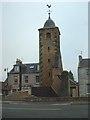
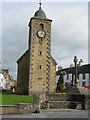
Clackmannan Toll Booth
The old Tollbooth, Merkit Cross and King Robert's Stone can be found in the centre of Clackmannan town. The tower is all that remains of the Tollbooth.
Image: © JThomas
Taken: 21 Aug 2005
0.03 miles
3
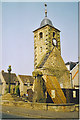
Clackmannan Tolbooth.
This clock tower has a name reflecting past use as a prison. Also visible are the Mercat Cross and the Mannan Stone from which gives the town's name is derived.
Image: © Colin Smith
Taken: Unknown
0.03 miles
4
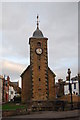
Clackmannan Tolbooth and Clock Tower
'Clackmannan Tolbooth' built in 1592 located on the main street of the town acted as the county gaol for 200 years.
Image: © John Chroston
Taken: 27 Jan 2008
0.04 miles
5
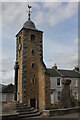
Clackmannan Tolbooth, Clackmannan Market Cross, Clackmannan Stone
All 3 subjects in the title of the photograph are Category A listed buildings on Main Street, Clackmannan.
Clackmannan Tolbooth: Dating originally from the 1590s with the tower added c.1680, the remains of the sandstone tolbooth consist of the west gable and bell-tower.
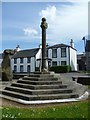
Clackmannan Market Cross: The stone cross probably dates from the 17th century. It stands on an octagonal stone stepped base which replaced similar steps in 2007.
Clackmannan Stone: Also known as the Stone of Mannan, the curious-looking Clackmannan Stone (between the tolbooth and the cross) is probably about 4000 years old.
Details of the listing of all 3 buildings can be found in https://www.britishlistedbuildings.co.uk/200406616-clackmannan-main-street-tolbooth-clackmannan#.WdT8pjGWw5s
Image: © G Laird
Taken: 3 Oct 2017
0.04 miles
6
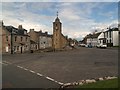
Clackmannan Tolbooth, Mercat Cross and Clackmannan Stone, Main Street, Clackmannan
All three structures are Category A Listed. The remaining Belfry Tower of the Tolbooth was built about 1680. The Act authorising the Tolbooth was passed in June 1592 and it was built at a cost of £284. The bell presented by Sir Lawrence Dundas in 1765 was, until 1939, rung each day at 6pm. The clock was donated in 1865. Ruinous by 1792 it was not abandoned until 1822 and then partly demolished. The market cross shaft is probably earlier, bearing chain marks of prisoners fastened to it, but the original capital bears the Bruce coat of arms donated by Sir Henry Bruce (about 1622-1674) in the mid 17th century. The ball finial was replaced from the Bruce mansion house after it was demolished in 1857, then restored in 1897. The octagonal steps were rebuilt in 1949 and replaced in 2007. Clackmannan is thought to be derived from the Mannan stone that was mounted on the whinstone block in 1833. Clog (stone) and Manau (Celtic sea-god) became Clog Manann and eventually Clackmannan (recorded from 12th century onwards). The stone, dated from the third or second millennium BC by some is pre-Christian and probably stood in Lookabootye Brae until moved to Clackmannan Tower and then mounted here on a stone brought from Abbey Craig. It was broken in pieces at an early date and bound together with iron rods.
Image: © Jo and Steve Turner
Taken: 20 Jun 2014
0.04 miles
8
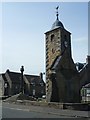
Tolbooth ruin
The tolbooth was erected in the late 16th century and the belfry tower was added in the following century. By 1792, although its courtroom was still in use, it was described as "a heap of ruins and a nuisance to the public" and partly demolished in 1822. The clock was added to the surviving tower in 1865.
Around 1800 the Sheriff Court moved to Alloa and the tolbooth ceased to be a place of public punishment. A plaque on the building describes the unusual punishment meted out to Robert Livingstone from Crook of Devon, who was convicted of stealing three sheep in 1699. He was sentenced, "to be stripped naked of his clothes and scourged by the hand of the hangman through the whole town of Clackmannan with one of the sheep's heads and four feet hanging about his neck, and thereafter to be banished out of the said shire."
Image: © kim traynor
Taken: 20 Jun 2013
0.04 miles
10
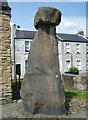
Stone of Mannan
A plaque on the adjacent tolbooth explains that the town takes its name from the ancient boulder known as the "clog" of "Mannan", from "Manau" a Celtic sea deity. It was originally located south of the town close to the shore of the River Forth before being removed to Clackmannan Tower. In 1833 the Bruce family had it raised onto the large stone block, dragged from the Abbey Craig at Stirling by a team of 16 horses.
Image: © kim traynor
Taken: 20 Jun 2013
0.04 miles