
IMAGES TAKEN NEAR TO
Upton Lane, LONDON, E7 9PS
Introduction
This page details the photographs taken nearby to Upton Lane, E7 9PS by members of the Geograph project.
The Geograph project started in 2005 with the aim of publishing, organising and preserving representative images for every square kilometre of Great Britain, Ireland and the Isle of Man.

There are currently over 7.5m images from over14,400 individuals and you can help contribute to the project by visiting https://www.geograph.org.uk
Image Map
Images are licensed for reuse under creativecommons.org/licenses/by-sa/2.0
Notes
- Clicking on the map will re-center to the selected point.
- The higher the marker number, the further away the image location is from the centre of the postcode.
Image Listing (32 Images Found)
Images are licensed for reuse under creativecommons.org/licenses/by-sa/2.0
Image
Details
Distance
1
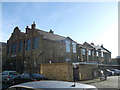
St Bonaventure's Catholic School, Upton
On Lancaster Road.
Image: © David Anstiss
Taken: 16 Dec 2012
0.02 miles
2
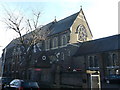
Church of St Antony's, Upton (2)
Large grade II listed church on the junction of St Antony's Road and Lancaster Road (in front).
See http://www.britishlistedbuildings.co.uk/en-204968-church-of-st-antony-and-monastery-greate for more details on the church.
Image: © David Anstiss
Taken: 16 Dec 2012
0.09 miles
3
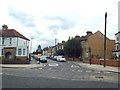
Boleyn Road, West Ham
Boleyn Road is a residential road in east London.
Image: © Malc McDonald
Taken: 3 Sep 2017
0.09 miles
4
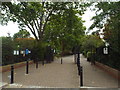
West Ham Park gate
This is one of several entrances to West Ham Park, in east London.
Image: © Malc McDonald
Taken: 3 Sep 2017
0.10 miles
5
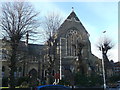
Church of St Antony's, Upton
Large grade II listed church on the junction of St Antony's Road and Lancaster Road.
See http://www.britishlistedbuildings.co.uk/en-204968-church-of-st-antony-and-monastery-greate for more details on the church.
Image: © David Anstiss
Taken: 16 Dec 2012
0.10 miles
6
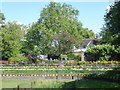
In the Ornamental Garden at West Ham Park
West Ham Park was formerly the grounds of a large mansion called Ham House, it was owned by Dr John Fothergill, an eminent Quaker physician and botanist, from 1762 until his death in 1780. During this time by commissioning plant hunters, Fothergill amassed a unique collection of several thousand plants and trees from every part of the habitable globe. The collection, partly housed in a run of hot and cold greenhouses 260 feet long, and also including an ornamental canal for aquatic plants, was considered by Sir Joseph Banks to be "second only to Kew" in importance. One of Fothergill's many successes was the first tea tree to flower in England. His main interest in botany was in plants which might be useful in medicine or for food. On one occasion he treated a sea captain with yellow fever and in lieu of payment requested that the captain bring him "two barrels of earth from Borneo, taken from as many points as possible". From this soil, many new plants were obtained and introduced into English gardens.
After Fothergill's death, the plant collection was sold and the greenhouses largely dismantled. The estate passed eventually to Samuel Gurney, a Quaker banker and philanthropist and brother of the prison reformer Elizabeth Fry. After his death in 1856, his grandson John Gurney wanted the estate preserved as an open space and offered it for £25,000. The family put up £10,000, the City Corporation £10,000 and the rest was raised by public subscription. The estate was then conveyed to the City Corporation, and West Ham Park was opened on 20th July 1874. It has been managed by the City ever since. The former site of Fothergill's ornamental canal can still be seen in parts of the park.
This view is within the Ornamental Garden looking towards East Lodge which is next to Main gate from Upton Lane.
Image: © Marathon
Taken: 21 Aug 2014
0.11 miles
7
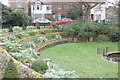
Spring bedding, West Ham Park
A very attractive, varied and well-maintained town park.
Image: © Trevor Harris
Taken: 6 Feb 2016
0.11 miles
8
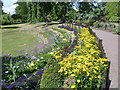
Flowers in West Ham Park
West Ham Park was formerly the grounds of a large mansion called Ham House, it was owned by Dr John Fothergill, an eminent Quaker physician and botanist, from 1762 until his death in 1780. During this time by commissioning plant hunters, Fothergill amassed a unique collection of several thousand plants and trees from every part of the habitable globe. The collection, partly housed in a run of hot and cold greenhouses 260 feet long, and also including an ornamental canal for aquatic plants, was considered by Sir Joseph Banks to be "second only to Kew" in importance. One of Fothergill's many successes was the first tea tree to flower in England. His main interest in botany was in plants which might be useful in medicine or for food. On one occasion he treated a sea captain with yellow fever and in lieu of payment requested that the captain bring him "two barrels of earth from Borneo, taken from as many points as possible". From this soil, many new plants were obtained and introduced into English gardens.
After Fothergill's death, the plant collection was sold and the greenhouses largely dismantled. The estate passed eventually to Samuel Gurney, a Quaker banker and philanthropist and brother of the prison reformer Elizabeth Fry. After his death in 1856, his grandson John Gurney wanted the estate preserved as an open space and offered it for £25,000. The family put up £10,000, the City Corporation £10,000 and the rest was raised by public subscription. The estate was then conveyed to the City Corporation, and West Ham Park was opened on 20th July 1874. It has been managed by the City ever since. The former site of Fothergill's ornamental canal can still be seen in parts of the park, as here with the depression on the left.
Image: © Marathon
Taken: 21 Aug 2014
0.12 miles
9
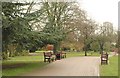
Gardens, West Ham Park
The formal gardens in the southeast corner of the park, on the site of Ham House, and which contain Image
Image: © Derek Harper
Taken: 12 Jan 2011
0.12 miles
10
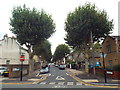
Neville Road, West Ham
Neville Road is a tree-lined residential road in West Ham, in east London.
Image: © Malc McDonald
Taken: 3 Sep 2017
0.14 miles