
IMAGES TAKEN NEAR TO
Fairburn Street, CASTLEFORD, WF10 1ND
Introduction
This page details the photographs taken nearby to Fairburn Street, WF10 1ND by members of the Geograph project.
The Geograph project started in 2005 with the aim of publishing, organising and preserving representative images for every square kilometre of Great Britain, Ireland and the Isle of Man.

There are currently over 7.5m images from over14,400 individuals and you can help contribute to the project by visiting https://www.geograph.org.uk
Image Map
Images are licensed for reuse under creativecommons.org/licenses/by-sa/2.0
Notes
- Clicking on the map will re-center to the selected point.
- The higher the marker number, the further away the image location is from the centre of the postcode.
Image Listing (51 Images Found)
Images are licensed for reuse under creativecommons.org/licenses/by-sa/2.0
Image
Details
Distance
1
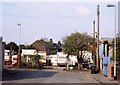
Marchant Street, Castleford
Several yards in the 'Potteries' district of Castleford are used for winter quarters and equipment storage by travelling showmen.
Image: © David Pickersgill
Taken: 7 Oct 2007
0.02 miles
2
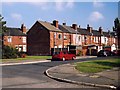
Stafford Street, Castleford
This area is still known as 'the Potteries' having been the centre of this industry in Castleford in the 19th and early 20th centuries.
Image: © David Pickersgill
Taken: 7 Oct 2007
0.06 miles
3

Old pottery, Castleford
These buildings on Pottery Street were part of Clokies pottery until its closure in 1961 and now house a variety of businesses. In the 1940s and 1950s the house was occupied by the man who supervised the firing of the traditional cone ovens.
Image: © David Pickersgill
Taken: 7 Oct 2007
0.08 miles
4

Pottery River
It's hard to believe now, but until the middle of the 20th century barges laden with clay would sail past the houses http://www.geograph.org.uk/photo/663824 as far as here to unload at the former Clokie & Co pottery in the buildings behind the trees. It's an old bend of the river Calder - an ox-bow lake beloved of geography teachers - but has been left to silt up since the pottery closed in 1961. Now usually known as Pumphouse Pond.
Image: © David Pickersgill
Taken: 20 Jan 2008
0.09 miles
5

Old pottery, Castleford
This site was the first and last place where pottery was manufactured in the town, seeing continuous production from David Dunderdale's Castleford Pottery established in 1790, through to Clokie & Co which closed in 1961. The remaining buildings date from the mid-19th century, the piles of coal mark the site of one of the cone ovens.
Image: © David Pickersgill
Taken: 7 Oct 2007
0.09 miles
6
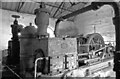
Whitwood Sewage Pumping Station, Castleford
This site is long since demolished and was derelict when seen. We were expecting a steam engine but found these motor driven reciprocating pumps. At first we accepted them on face value but after a while I got thinking and persuaded the others that they were converted from an original steam engine. I was able to come up with a conjectural layout and that was later confirmed by a contemporary engineering journal. We now know they were built as two singles that could be run individually or coupled. They were built by Joshua Horne of Providence Ironworks, Castleford in 1882. The steam cylinders had been 12.5" x 2' and the pump cylinders were 14" x 2'. The two flywheels were each 6' diameter. As rebuilt an induction motor drove by belt to a new shaft geared down to the crankshaft by herringbone gearing. So, what started as a damp squib actually became quite interesting.
Image: © Chris Allen
Taken: 20 Feb 1982
0.10 miles
7
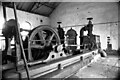
Whitwood Sewage Pumping Station, Castleford
This site is long since demolished and was derelict when seen. We were expecting a steam engine but found these motor driven reciprocating pumps. At first we accepted them on face value but after a while I got thinking a persuaded the others that they were converted from an original steam engine. I was able to come up with a conjectural layout and that was later confirmed by a contemporary engineering journal. We now know they were built as two singles that could be run individually or coupled. They were built by Joshua Horne of Providence Ironworks, Castleford in 1882. The steam cylinders had been 12.5" x 2' and the pump cylinders were 14" x 2'. The two flywheels were each 6' diameter. As rebuilt an induction motor drove by belt to a new shaft geared down to the crankshaft by herringbone gearing. So, what started as a damp squib actually became quite interesting.
Image: © Chris Allen
Taken: 20 Feb 1982
0.10 miles
8
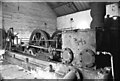
Whitwood Sewage Pumping Station, Castleford
This site is long since demolished and was derelict when seen. We were expecting a steam engine but found these motor driven reciprocating pumps. At first we accepted them on face value but after a while I got thinking a persuaded the others that they were converted from an original steam engine. I was able to come up with a conjectural layout and that was later confirmed by a contemporary engineering journal. We now know they were built as two singles that could be run individually or coupled. They were built by Joshua Horne of Providence Ironworks, Castleford in 1882. The steam cylinders had been 12.5" x 2' and the pump cylinders were 14" x 2'. The two flywheels were each 6' diameter. As rebuilt an induction motor drove by belt to a new shaft geared down to the crankshaft by herringbone gearing. So, what started as a damp squib actually became quite interesting.
Image: © Chris Allen
Taken: 20 Feb 1982
0.10 miles
9
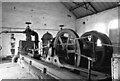
Whitwood Sewage Pumping Station, Castleford
This site is long since demolished and was derelict when seen. We were expecting a steam engine but found these motor driven reciprocating pumps. At first we accepted them on face value but after a while I got thinking a persuaded the others that they were converted from an original steam engine. I was able to come up with a conjectural layout and that was later confirmed by a contemporary engineering journal. We now know they were built as two singles that could be run individually or coupled. They were built by Joshua Horne of Providence Ironworks, Castleford in 1882. The steam cylinders had been 12.5" x 2' and the pump cylinders were 14" x 2'. The two flywheels were each 6' diameter. As rebuilt an induction motor drove by belt to a new shaft geared down to the crankshaft by herringbone gearing. So, what started as a damp squib actually became quite interesting.
Image: © Chris Allen
Taken: 20 Feb 1982
0.10 miles
10
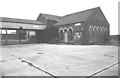
Whitwood Sewage Pumping Station
Now demolished, this contained a pumping engine. We had been told it was a steam engine but at first glance it was obviously electric motor driven. Detailed examination showed that it had been steam once and we were able to deduce its possible configuration. This was later confirmed from a contemporary account. Access was through the top half of one of the arched windows.
Image: © Chris Allen
Taken: 20 Feb 1982
0.10 miles