
IMAGES TAKEN NEAR TO
Sinns Common, REDRUTH, TR16 4BH
Introduction
This page details the photographs taken nearby to TR16 4BH by members of the Geograph project.
The Geograph project started in 2005 with the aim of publishing, organising and preserving representative images for every square kilometre of Great Britain, Ireland and the Isle of Man.

There are currently over 7.5m images from over14,400 individuals and you can help contribute to the project by visiting https://www.geograph.org.uk
Image Map
Images are licensed for reuse under creativecommons.org/licenses/by-sa/2.0
Notes
- Clicking on the map will re-center to the selected point.
- The higher the marker number, the further away the image location is from the centre of the postcode.
Image Listing (21 Images Found)
Images are licensed for reuse under creativecommons.org/licenses/by-sa/2.0
Image
Details
Distance
1
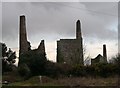
Engine Houses, Wheal Peevor
This disused mine is currently undergoing preservation work.
Image: © Tony Atkin
Taken: 31 Dec 2005
0.08 miles
2
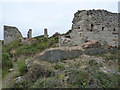
Wheal Peevor - the remains of the calciners
Brunton Calciners were an important part of the tin mining and processing system, as they removed a variety of impurities (copper, arsenic, iron) from the concentrate before it was further processed and smelted. Most of this involved huge amounts of heat, and took place in these calciners.
Image: © Richard Law
Taken: 16 Sep 2012
0.13 miles
3
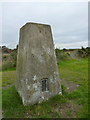
North Downs trig - closeup
The pillar itself is in good condition, as is the flushbracket. Sadly, the 'man with the allen key' has long since helped himself to the brasswork from the top.
Image: © Richard Law
Taken: 16 Sep 2012
0.14 miles
4

The North Downs trig
A trig point sporting flushbracket S7758, situated immediately adjacent to an infilled shaft south of the Wheal Plenty complex.
Image: © Richard Law
Taken: 16 Sep 2012
0.14 miles
6
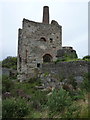
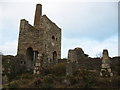
The stamps engine house
The remains of the engine house that ran the tin stamps at Wheal Peevor; the stamps, as the name suggests, were essentially ore crushers, breaking relatively small lumps of ore into finer material (stamp sand) ready for processing in the nearby buddles Image
It originally housed a 36" rotative beam engine, installed in 1876, but when the mine was re-activated in 1911, alterations were made; these included the installation of a gas-oil powered engine which ran more equipment, including a machine of 20 Californian stamps.
Image: © Richard Law
Taken: 16 Sep 2012
0.14 miles
7
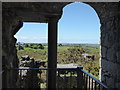
View from the stamps engine house Wheal Peevor
This is the view from inside the house for the 32" stamps engine at Wheal Peevor. Erected in 1876 to drive a set of Cornish stamps (for crushing the ore). The cylinder opening is not in the rear wall but is in the south side wall where I had entered the building to look through the west wall. In 1912 the steam engine was replaced by a 150 horsepower gas-oil engine driving new Californian stamps. The plug door was widened to accommodate the drive built and this account for the odd-shaped opening in the bob wall. In the distance to the left is the 22" inch stamps engine house for West Peevor mine. This is on private land and in a dangerous condition.
Image: © Chris Allen
Taken: 14 May 2018
0.15 miles
8
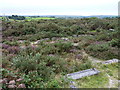
Wheal Peevor - 3 buddles from near the calciner ruins
The remains of three tin 'buddles' which were used, in conjunction with water, as a mechanism for separating tin particles from rock and waste products, prior to further refining. For a closer view, see Image
Image: © Richard Law
Taken: 16 Sep 2012
0.15 miles
9
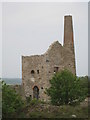
Stamps Engine House at Wheal Peevor
There is a fine collection of engine houses and other mine workings at Wheal Peevor which have recently been consolidated to prevent further decay. There are very informative notice boards which explain the history of the site and the functions of the various buildings.
Image: © Rod Allday
Taken: 14 May 2008
0.15 miles
10
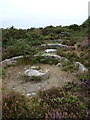
Buddles at Wheal Peevor mine
The remains of three tin 'buddles' in front of the Stamps Engine House; these were separated tin particles from lighter materials, with water as a part of the process.
Image: © Richard Law
Taken: 16 Sep 2012
0.15 miles