
IMAGES TAKEN NEAR TO
Fir Tree Close, NORWICH, NR13 5RN
Introduction
This page details the photographs taken nearby to Fir Tree Close, NR13 5RN by members of the Geograph project.
The Geograph project started in 2005 with the aim of publishing, organising and preserving representative images for every square kilometre of Great Britain, Ireland and the Isle of Man.

There are currently over 7.5m images from over14,400 individuals and you can help contribute to the project by visiting https://www.geograph.org.uk
Image Map
Images are licensed for reuse under creativecommons.org/licenses/by-sa/2.0
Notes
- Clicking on the map will re-center to the selected point.
- The higher the marker number, the further away the image location is from the centre of the postcode.
Image Listing (47 Images Found)
Images are licensed for reuse under creativecommons.org/licenses/by-sa/2.0
Image
Details
Distance
1

Buddleia
This shrub is also known as summer lilac, butterfly-bush, or orange eye, and native to Sichuan and Hubei provinces in central China and Japan. It was first introduced to Europe in the late 19th century and can be found in many gardens although it is actually classified as an invasive species and apparently is a problem on British railways where it interferes with overhead power lines and obscures signals. Buddleia is recommended by butterfly conservationists because it is a valuable source of nectar for butterflies and other insects.
Image: © Evelyn Simak
Taken: 8 Jul 2017
0.10 miles
2
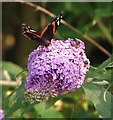
Red Admiral butterfly (Vanessa atalanta) on Buddleia
Red Admirals are commonly found in damp environments such as marshes, woods, fields, and well-watered gardens. These butterflies cannot stand extreme winter cold and migrate southwards during the winter months to warmer climates. During their migration they can be found in habitats ranging from subtropics to tundras.
Buddleia is also known as summer lilac, butterfly-bush, or orange eye, and native to Sichuan and Hubei provinces in central China and Japan. It was first introduced to Europe in the late 19th century and can be found in many gardens although it is actually classified as an invasive species and apparently is a problem on British railways where it interferes with overhead power lines and obscures signals. Buddleia is recommended by butterfly conservationists because it is a valuable source of nectar for butterflies and other insects.
Image: © Evelyn Simak
Taken: 8 Jul 2017
0.10 miles
3

Buddleia
This shrub is also known as summer lilac, butterfly-bush, or orange eye, and native to Sichuan and Hubei provinces in central China and Japan. It was first introduced to Europe in the late 19th century and can be found in many gardens although it is actually classified as an invasive species and apparently is a problem on British railways where it interferes with overhead power lines and obscures signals. Buddleia is recommended by butterfly conservationists because it is a valuable source of nectar for butterflies and other insects.
Image: © Evelyn Simak
Taken: 8 Jul 2017
0.10 miles
4
Buddleia
This shrub is also known as summer lilac, butterfly-bush, or orange eye, and native to Sichuan and Hubei provinces in central China and Japan. It was first introduced to Europe in the late 19th century and can be found in many gardens although it is actually classified as an invasive species and apparently is a problem on British railways where it interferes with overhead power lines and obscures signals. Buddleia is recommended by butterfly conservationists because it is a valuable source of nectar for butterflies and other insects.
Image: © Evelyn Simak
Taken: 8 Jul 2017
0.10 miles
5
Buddleia
This shrub is also known as summer lilac, butterfly-bush, or orange eye, and native to Sichuan and Hubei provinces in central China and Japan. It was first introduced to Europe in the late 19th century and can be found in many gardens although it is actually classified as an invasive species and apparently is a problem on British railways where it interferes with overhead power lines and obscures signals. Buddleia is recommended by butterfly conservationists because it is a valuable source of nectar for butterflies and other insects.
Image: © Evelyn Simak
Taken: 8 Jul 2017
0.10 miles
6
Buddleia
This shrub is also known as summer lilac, butterfly-bush, or orange eye, and native to Sichuan and Hubei provinces in central China and Japan. It was first introduced to Europe in the late 19th century and can be found in many gardens although it is actually classified as an invasive species and apparently is a problem on British railways where it interferes with overhead power lines and obscures signals. Buddleia is recommended by butterfly conservationists because it is a valuable source of nectar for butterflies and other insects.
Image: © Evelyn Simak
Taken: 8 Jul 2017
0.10 miles
7
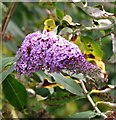
Buddleia
This shrub is also known as summer lilac, butterfly-bush, or orange eye, and native to Sichuan and Hubei provinces in central China and Japan. It was first introduced to Europe in the late 19th century and can be found in many gardens although it is actually classified as an invasive species and apparently is a problem on British railways where it interferes with overhead power lines and obscures signals. Buddleia is recommended by butterfly conservationists because it is a valuable source of nectar for butterflies and other insects.
Image: © Evelyn Simak
Taken: 8 Jul 2017
0.10 miles
8
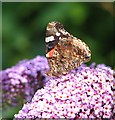
Red Admiral butterfly (Vanessa atalanta) on Buddleia
Red Admirals are commonly found in damp environments such as marshes, woods, fields, and well-watered gardens. These butterflies cannot stand extreme winter cold and migrate southwards during the winter months to warmer climates. During their migration they can be found in habitats ranging from subtropics to tundras.
Buddleia is also known as summer lilac, butterfly-bush, or orange eye, and native to Sichuan and Hubei provinces in central China and Japan. It was first introduced to Europe in the late 19th century and can be found in many gardens although it is actually classified as an invasive species and apparently is a problem on British railways where it interferes with overhead power lines and obscures signals. Buddleia is recommended by butterfly conservationists because it is a valuable source of nectar for butterflies and other insects.
Image: © Evelyn Simak
Taken: 8 Jul 2017
0.10 miles
9
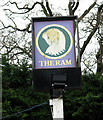
The Ram public house (pub sign)
For a view of this pub see > http://www.geograph.org.uk/photo/5315688.
Image: © Evelyn Simak
Taken: 18 Mar 2017
0.14 miles
10
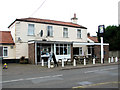
The Ram public house in Brundall
Edward Cock was the first licensee of the Ram Inn in 1836. In December 2012 the pub was threatened with closure and conversion to a supermarket but thankfully it is still open in 2017. In March 2013 it was awarded "Asset of Community Value" status. The house dates from the late 17th century.
Image: © Evelyn Simak
Taken: 18 Mar 2017
0.14 miles