
IMAGES TAKEN NEAR TO
Freethorpe Road, NORWICH, NR13 3HD
Introduction
This page details the photographs taken nearby to Freethorpe Road, NR13 3HD by members of the Geograph project.
The Geograph project started in 2005 with the aim of publishing, organising and preserving representative images for every square kilometre of Great Britain, Ireland and the Isle of Man.

There are currently over 7.5m images from over14,400 individuals and you can help contribute to the project by visiting https://www.geograph.org.uk
Image Map
Images are licensed for reuse under creativecommons.org/licenses/by-sa/2.0
Notes
- Clicking on the map will re-center to the selected point.
- The higher the marker number, the further away the image location is from the centre of the postcode.
Image Listing (78 Images Found)
Images are licensed for reuse under creativecommons.org/licenses/by-sa/2.0
Image
Details
Distance
1

Bridge 1236 at Reedham station
For a full view of this bridge see > http://www.geograph.org.uk/photo/1480873. The bridge takes Freethorpe Road over the Reedham to Yarmouth railway line.
Image: © Evelyn Simak
Taken: 14 Mar 2010
0.05 miles
2

New supplies arriving at Reedham station
Class 66 diesel locomotive 66713 'Forest City' bringing supplies of sand and crushed stone ballast, squeezing past underneath the bridge which takes Freethorpe Road over the railway.
The line between Reedham and Cantley is closed over the weekend whilst a new track is being laid > http://www.geograph.org.uk/photo/1753536. The old rails and sleepers have been removed > http://www.geograph.org.uk/photo/1751738. They were replaced over night by a new track. Diesel locomotives such as the low emission Class 66725 'Sunderland' > http://www.geograph.org.uk/photo/1753545 have brought the required materials such as rails, sleepers, sand and crushed stone ballast to the section being presently worked on. The trains have also brought a crane, a digger that can move on rails > http://www.geograph.org.uk/photo/1754244 and a JCB. The men will be working day and night so as not to disrupt rail traffic for any longer than necessary and the portable lights positioned along the lineside will illuminate the track at night.
The new section of track can be seen at left: rails and concrete sleepers are resting on a new bed of crushed stone ballast. Some of the workers are busy fitting the last fishplates to join the lengths of rails, and everybody is waiting for more sand and stones to arrive.
Image: © Evelyn Simak
Taken: 14 Mar 2010
0.05 miles
3

Laying a new track at Reedham station
Some of the workers are busy fitting the last fishplates to join the length of rails, and everybody is waiting for more sand and stones to arrive > http://www.geograph.org.uk/photo/1754217. A Case Super Railer - it can move on rails - has just arrived at the station platform, bringing back from a work site a short distance further down the line a load of old concrete sleepers with lengths of rails still attached to them.
The line between Reedham and Cantley is closed over the weekend whilst a new track is being laid > http://www.geograph.org.uk/photo/1753536. The old rails and sleepers have been removed > http://www.geograph.org.uk/photo/1751738. They were replaced over night by a new track. Diesel locomotives such as the low emission Class 66725 'Sunderland' > http://www.geograph.org.uk/photo/1753545 have brought the required materials such as rails, sleepers, sand and crushed stone ballast to the section being presently worked on. The trains have also brought a crane, a digger that can move on rails > http://www.geograph.org.uk/photo/1754244 and a JCB. The men will be working day and night so as not to disrupt rail traffic for any longer than necessary and the portable lights positioned along the lineside will illuminate the track at night.
Image: © Evelyn Simak
Taken: 14 Mar 2010
0.05 miles
4

Reedham Railway Station
It was in May 1844 that the first railway in Norfolk opened, with a line from Great Yarmouth to Norwich. The Yarmouth and Norwich Railway & Co was created in 1842, George Stephenson was the chairman at the first directors' meeting.
The line was constructed as a single track standard gauge line with little engineering headaches, no tunnels or massive viaducts, following the low level course of the River Yare. Work began in April 1843, at Postwick Hall Farm, near Thorpe Asylum,1,500 men were employed in its construction. The contractors were Grissell and Peto, Samuel Morton Peto being the main engineer. The station was similar design to Beccles Station Image] which was built by Peto Brassey and Betts. Grissell became increasingly nervous of the risks taken by Peto and so dissolved the partnership in 1846. Peto then entered into partnership with Edward Betts, who had married his sister, Ann.
Opening came on Wednesday, 1st of May 1844 next. Trains left Norwich Image] at 9 and 11 o‘clock in the morning, and 4 and 7 o‘clock in the afternoon.
The 30th April 1844 saw the formal opening of the Yarmouth and Norwich line. Around 200 VIPs travelled in the first train. By 1845 Trowse swingbridge had been constructed Image] allowing through services to London via the again Grissel and Peto built Norwich to Brandon and Eastern Counties railway lines.
The roundabout journey of 146 miles took about six-and-a-quarter hours killing off the horse drawn carriage trade. This was a huge moment in my family history as my Great Great Grandfather Sir Walter Gilby was put out of business by the railways in the 1840s.
Image: © Ashley Dace
Taken: 22 Jun 2010
0.05 miles
5

A Lowestoft bound train departing from Reedham
Reedham currently retains its mechanical signalbox and semaphore signals but it is planned that the area will be re-signalled in 2015. Reedham swing bridge box will be retained. See Image
Image: © John Lucas
Taken: 15 Aug 2011
0.05 miles
6

Reedham station photo-survey (9)
The down platform starter signal at Reedham station. The signal arm is raised to the clear or 'off' position for a Lowestoft-bound train (see [http://www.geograph.org.uk/photo/1478283]).
Reedham is on the ex-Great Eastern Rly route from Norwich to Lowestoft and is situated roughly mid-way between the two towns. The station has two platforms, one for up (Norwich-bound) traffic and one for down (Yarmouth and Lowestoft) traffic. The majority of passenger services are operated by National Express.
Image: © Andy F
Taken: 6 Sep 2009
0.06 miles
7

Reedham station photo-survey (5)
Looking east - the down direction - at Reedham station from the disused platform of the cattle dock. As well as the up home signal and the steel relay cabinets, other details include the dock's rail-built fencing (extreme right of the photo) and the gantry which once supported a loading gauge. The gauge was used to ensure wagons and vans weren't loaded too high and the gantry of steel angle is supported on a cast concrete post. Reedham Junction signal box can be seen in the distance.
Reedham station is on the ex-Great Eastern Rly route from Norwich to Lowestoft and is situated roughly mid-way between the two towns. The station has two platforms, one for up (Norwich-bound) traffic and one for down (Yarmouth and Lowestoft) traffic. The majority of passenger services are operated by National Express.
Half-a-mile east of the station is Reedham Junction; a single track route branches northeast to Yarmouth and the double track route continues southeast to Lowestoft. The junction is controlled by a traditional lever-frame signal box between the station and the junction itself.
Image: © Andy F
Taken: 6 Sep 2009
0.06 miles
8
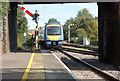
Reedham station photo-survey (3)
National Express class 170 diesel unit 170206 on a Norwich-Lowestoft service departing from Reedham railway station. The train has just passed under the road bridge which spans the station. The upper quadrant semaphore signal (its arm raised to the clear or 'off' position) is on a short post to ensure its visibility is not obscured by the bridge (compare with the height of the signal post to the right of the train).
Reedham station is on the ex-Great Eastern Rly route from Norwich to Lowestoft and is situated roughly mid-way between the two towns. The station has two platforms, one for up (Norwich-bound) traffic and one for down (Yarmouth and Lowestoft) traffic. The majority of passenger services are operated by National Express.
Half-a-mile east of the station is Reedham Junction; a single track route branches northeast to Yarmouth and the double track route continues southeast to Lowestoft. The junction is controlled by a traditional lever-frame signal box between the station and the junction itself.
Image: © Andy F
Taken: 6 Sep 2009
0.06 miles

10

Reedham station photo-survey (16)
Looking in the up (westbound) direction from the bridge carrying Witton Green over the railway east of Reedham station. The main station building and the platforms can be seen clearly.
Reedham station has two platforms, one for up (Norwich-bound) traffic and one for down (Yarmouth and Lowestoft) traffic. The majority of passenger services are operated by National Express.
Reedham station is on the ex-Great Eastern Rly route from Norwich to Lowestoft. The bracketed signal [http://www.geograph.org.uk/photo/1480859] on the right of this photo controls down (eastbound) traffic approaching Reedham Junction which is 400 metres east (behind the photographer). A single track route branches northeast to Yarmouth and the double track route continues southeast to Lowestoft.
Image: © Andy F
Taken: 6 Sep 2009
0.06 miles