
IMAGES TAKEN NEAR TO
Maritime Way, CHATHAM, ME4 4QT
Introduction
This page details the photographs taken nearby to Maritime Way, ME4 4QT by members of the Geograph project.
The Geograph project started in 2005 with the aim of publishing, organising and preserving representative images for every square kilometre of Great Britain, Ireland and the Isle of Man.

There are currently over 7.5m images from over14,400 individuals and you can help contribute to the project by visiting https://www.geograph.org.uk
Image Map
Images are licensed for reuse under creativecommons.org/licenses/by-sa/2.0
Notes
- Clicking on the map will re-center to the selected point.
- The higher the marker number, the further away the image location is from the centre of the postcode.
Image Listing (174 Images Found)
Images are licensed for reuse under creativecommons.org/licenses/by-sa/2.0
Image
Details
Distance
1
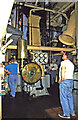
SS Jeremiah O'Brien, Chatham - engine
The Jeremiah O'Brien is a WWII 'Liberty' cargo ship built in 1943 and now preserved in San Francisco. She came to Europe for the 50th anniversary of D-Day. The vessel is 441' 6" long by 57' beam. The displacement tonnage is 14,450 long tons. Propulsion is by this 2,500 horsepower inverted vertical triple expansion engine. The cylinders are 24.5", 37" & 70" bores by 48" stroke. Steam pressure is 220 psi and service speed 76 rpm.
This is the forward starboard side of the engine. The buff column covered with pipes is supporting the high pressure cylinder. The brass disc above a silver steam cylinder is the reversing gear. The boilers are to the right. The brass cylinder dangling on the left is a bell, presumably for sounding the watch changes. It was rather busy down here and the engine was too big to get in one frame anyway. This and a view from the generator flat was about as good as it got.
The engine, two boilers and all the auxiliary plant share one large space amidships. One torpedo amidships would take out the lot.
The Liberty ships were a standardised class known as the EC2-S-C1 cargo vessel and 2710 were built. The fastest build time was 4 days, 15 hours and 29 minutes from laying the keel to launch. The actual time from laying the keel to delivery into service was a bit longer at 7 days, 14 hours and 32 minutes.
One of the items in my collection is the official Instruction Manual for this class of engine. This was printed in 1942 in Hamilton, Ohio.
Image: © Chris Allen
Taken: 11 Jun 1994
0.01 miles
2
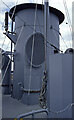
SS Jeremiah O'Brien, Chatham - funnel
The Jeremiah O'Brien is a WWII 'Liberty' cargo ship built in 1943 and now preserved in San Francisco. She came to Europe for the 50th anniversary of D-Day. The vessel is 441' 6" long by 57' beam. The displacement tonnage is 14,450 long tons. Propulsion is by a 2,500 horsepower inverted vertical triple expansion engine. The cylinders are 24.5", 37" & 70" bores by 48" stroke. Steam pressure is 220 psi and service speed 76 rpm.
This is the funnel behind the bridge with the engine room ventilators flanking it. The steam whistle is top left. The high voltage insulators on the right are for the radio aerials.
The engine, two boilers and all the auxiliary plant share one large space amidships. One torpedo amidships would take out the lot.
The Liberty ships were a standardised class known as the EC2-S-C1 cargo vessel and 2710 were built. The fastest build time was 4 days, 15 hours and 29 minutes from laying the keel to launch. The actual time from laying the keel to delivery into service was a bit longer at 7 days, 14 hours and 32 minutes.
Seeing this gorgeous vessel in the UK was a real treat as I have yet to get to San Francisco, Baltimore or Piraeus to catch up with the survivors in their usual ports.
Image: © Chris Allen
Taken: 11 Jun 1994
0.01 miles
3
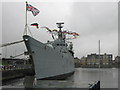
HMS Chatham in No.2 Basin (2)
As seen from the wharf path near South Side Road.
This warship is in Chatham to mark the 20th anniversary of the ship's commissioning at Chatham in 1990,(outside a Naval Dockyard). It was open on Saturday and Sunday for tours around the ship.
See http://news.bbc.co.uk/local/kent/hi/things_to_do/newsid_9167000/9167595.stm for more details.
See http://en.wikipedia.org/wiki/HMS_Chatham_(F87) for more details about the ship.
Image: © David Anstiss
Taken: 14 Nov 2010
0.01 miles
4
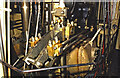
SS Jeremiah O'Brien, Chatham - engine
The Jeremiah O'Brien is a WWII 'Liberty' cargo ship built in 1943 and now preserved in San Francisco. She came to Europe for the 50th anniversary of D-Day. The vessel is 441' 6" long by 57' beam. The displacement tonnage is 14,450 long tons. Propulsion is by a 2,500 horsepower inverted vertical triple expansion engine. The cylinders are 24.5", 37" & 70" bores by 48" stroke. Steam pressure is 220 psi and service speed 76 rpm.
This is the forward end of the middle level of the engine looking to port. The main feature is the Stephenson link reversing motion for the high pressure cylinder. The HP piston rod and forked little end of the connecting rod are to the left. The big buff-coloured object is one end of the surface condenser.
The engine, two boilers and all the auxiliary plant share one large space amidships. One torpedo amidships would take out the lot.
The Liberty ships were a standardised class known as the EC2-S-C1 cargo vessel and 2710 were built. The fastest build time was 4 days, 15 hours and 29 minutes from laying the keel to launch. The actual time from laying the keel to delivery into service was a bit longer at 7 days, 14 hours and 32 minutes.
Seeing this gorgeous vessel in the UK was a real treat as I have yet to get to San Francisco, Baltimore or Piraeus to catch up with the survivors in their usual ports.
Image: © Chris Allen
Taken: 11 Jun 1994
0.01 miles
5
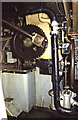
SS Jeremiah O'Brien, Chatham - reversing engine
The Jeremiah O'Brien is a WWII 'Liberty' cargo ship built in 1943 and now preserved in San Francisco. She came to Europe for the 50th anniversary of D-Day. The vessel is 441' 6" long by 57' beam. The displacement tonnage is 14,450 long tons. Propulsion is by a 2,500 horsepower inverted vertical triple expansion engine. The cylinders are 24.5", 37" & 70" bores by 48" stroke. Steam pressure is 220 psi and service speed 76 rpm.
This is the lower level of the engine room showing the reversing engine attached to the main engine. The reversing engine cylinder is bottom right and is 5" bore x 7" stroke. It turns the worm and worm wheel more or less in the centre of the view. The diagonal rod running from the worm wheel moves the reversing links. The worm wheel moves continuously in one direction and the reversing gear is therefore known as 'all around gear'. Seen on edge at the right is the flywheel that also doubles a manual reversing wheel if the engine fails or there is no steam (hard work) The flywheel has a circular brass cover that not only looks pretty but prevents the crew getting caught by the rapidly revolving spokes.
The engine, two boilers and all the auxiliary plant share one large space amidships. One torpedo amidships would take out the lot.
The Liberty ships were a standardised class known as the EC2-S-C1 cargo vessel and 2710 were built. The fastest build time was 4 days, 15 hours and 29 minutes from laying the keel to launch. The actual time from laying the keel to delivery into service was a bit longer at 7 days, 14 hours and 32 minutes.
Seeing this gorgeous vessel in the UK was a real treat as I have yet to get to San Francisco, Baltimore or Piraeus to catch up with the survivors in their usual ports.
I am using Geograph as a means of sharing this knowledge that would otherwise be less available.
Image: © Chris Allen
Taken: 11 Jun 1994
0.01 miles
6
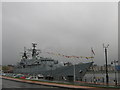
HMS Chatham in No.2 Basin
As seen from Maritime Way.
This warship is in Chatham to mark the 20th anniversary of the ship's commissioning at Chatham in 1990,(outside a Naval Dockyard). It was open on Saturday and Sunday for tours around the ship.
See http://news.bbc.co.uk/local/kent/hi/things_to_do/newsid_9167000/9167595.stm for more details.
See http://en.wikipedia.org/wiki/HMS_Chatham_(F87) for more details about the ship.
Image: © David Anstiss
Taken: 14 Nov 2010
0.02 miles
7
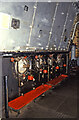
SS Jeremiah O'Brien, Chatham - boiler
The Jeremiah O'Brien is a WWII 'Liberty' cargo ship built in 1943 and now preserved in San Francisco. She came to Europe for the 50th anniversary of D-Day. The vessel is 441' 6" long by 57' beam. The displacement tonnage is 14,450 long tons. Propulsion is by a 2,500 horsepower inverted vertical triple expansion engine. The cylinders are 24.5", 37" & 70" bores by 48" stroke. Steam pressure is 220 psi and service speed 76 rpm.
This is one of the two water tube boilers. I believe I am looking forward and this is the port boiler. This is a Babcock and Wilcox section header, 2-inch tube design. It can evaporate 24,000 lbs per hour at 220 psi and 450 degrees Fahrenheit. There are four oil burners. The starboard boiler faces it across the firing aisle and the engine is immediately aft.
The engine, two boilers and all the auxiliary plant share one large space amidships. One torpedo amidships would take out the lot.
The Liberty ships were a standardised class known as the EC2-S-C1 cargo vessel and 2710 were built. The fastest build time was 4 days, 15 hours and 29 minutes from laying the keel to launch. The actual time from laying the keel to delivery into service was a bit longer at 7 days, 14 hours and 32 minutes.
Seeing this gorgeous vessel in the UK was a real treat as I have yet to get to San Francisco, Baltimore or Piraeus to catch up with the survivors in their usual ports.
Image: © Chris Allen
Taken: 11 Jun 1994
0.02 miles
8
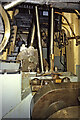
SS Jeremiah O'Brien, Chatham - engine
The Jeremiah O'Brien is a WWII 'Liberty' cargo ship built in 1943 and now preserved in San Francisco. She came to Europe for the 50th anniversary of D-Day. The vessel is 441' 6" long by 57' beam. The displacement tonnage is 14,450 long tons. Propulsion is by a 2,500 horsepower inverted vertical triple expansion engine. The cylinders are 24.5", 37" & 70" bores by 48" stroke. Steam pressure is 220 psi and service speed 76 rpm.
This is the main engine lower level looking aft. The high pressure crank is nearest the camera with the intermediate pressure crank beyond. The two thinner rods heading up are for the intermediate pressure valve gear. The gear on the left and rod top left are part of the 'all around' reversing gear.
The engine, two boilers and all the auxiliary plant share one large space amidships. One torpedo amidships would take out the lot.
The Liberty ships were a standardised class known as the EC2-S-C1 cargo vessel and 2710 were built. The fastest build time was 4 days, 15 hours and 29 minutes from laying the keel to launch. The actual time from laying the keel to delivery into service was a bit longer at 7 days, 14 hours and 32 minutes.
Seeing this gorgeous vessel in the UK was a real treat as I have yet to get to San Francisco, Baltimore or Piraeus to catch up with the survivors in their usual ports.
Image: © Chris Allen
Taken: 11 Jun 1994
0.02 miles
9
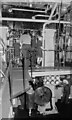
SS Jeremiah O'Brien, Chatham - engine
The Jeremiah O'Brien is a WWII 'Liberty' cargo ship built in 1943 and now preserved in San Francisco. She came to Europe for the 50th anniversary of D-Day. The vessel is 441' 6" long by 57' beam. The displacement tonnage is 14,450 long tons. Propulsion is by a 2,500 horsepower inverted vertical triple expansion engine. The cylinders are 24.5", 37" & 70" bores by 48" stroke. Steam pressure is 220 psi and service speed 76 rpm. The engine overall weighs about 271,000 pounds.
This is the main engine seen from the generator flat and shows nearly the full height and about half the length - reaching to the middle of the starboard middle cylinder support on the extreme left. The cylinders are at the top. The gauges are hung on the starboard support for the high pressure cylinder (this lump of metal weighs 6400 pounds). The circular shiny disc with a steam cylinder below is the reversing engine. It was very busy down here and this was about as good an overview as I could achieve. The far side of the engine was a bit better and I was able to get some good close ups of the machinery.
The engine, two boilers and all the auxiliary plant share one large space amidships. One torpedo amidships would take out the lot.
The Liberty ships were a standardised class known as the EC2-S-C1 cargo vessel and 2710 were built. The fastest build time was 4 days, 15 hours and 29 minutes from laying the keel to launch. The actual time from laying the keel to delivery into service was a bit longer at 7 days, 14 hours and 32 minutes.
Seeing this gorgeous vessel in the UK was a real treat as I have yet to get to San Francisco, Baltimore or Piraeus to catch up with the survivors in their usual ports.
Image: © Chris Allen
Taken: 11 Jun 1994
0.02 miles
10
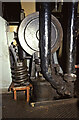
SS Jeremiah O'Brien, Chatham - turning gear
This is at the after starboard end of the main engine looking forward. This little vertical single cylinder engine is 8.5" bore x 7" stroke. It turns the main engine for adjustments to be made. This is achieved by the worm on the left engaging with the worm wheel on the crankshaft. The worm is in its disengaged storage position. When the worm is in the main engine cannot be turned other than by the turning gear engine and attempts to do so could cause damage. Therefore, marine engine rooms usually have a big 'turning gear engaged' notice that can be hung from the main engine stop valve.
Image: © Chris Allen
Taken: 11 Jun 1994
0.02 miles