
IMAGES TAKEN NEAR TO
Bridge Street, THETFORD, IP24 3AH
Introduction
This page details the photographs taken nearby to Bridge Street, IP24 3AH by members of the Geograph project.
The Geograph project started in 2005 with the aim of publishing, organising and preserving representative images for every square kilometre of Great Britain, Ireland and the Isle of Man.

There are currently over 7.5m images from over14,400 individuals and you can help contribute to the project by visiting https://www.geograph.org.uk
Image Map
Images are licensed for reuse under creativecommons.org/licenses/by-sa/2.0
Notes
- Clicking on the map will re-center to the selected point.
- The higher the marker number, the further away the image location is from the centre of the postcode.
Image Listing (626 Images Found)
Images are licensed for reuse under creativecommons.org/licenses/by-sa/2.0
Image
Details
Distance
1
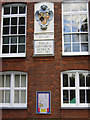
Thetford Girls' Grammar School
The Girls' Grammar School was established in Victorian times as a counterpart to the very long-established boys' school across the road. The two schools merged in 1975 and became an independent grammar school in 1981. The former girls' school buildings are now used to accommodate the junior section of the school.
Image: © Stephen McKay
Taken: 25 Sep 2010
0.00 miles
2
![Thetford houses [13]](https://s3.geograph.org.uk/geophotos/06/71/52/6715279_03ac151d_120x120.jpg)
Thetford houses [13]
Ivy Lodge, number 23 Bridge Street, is an early 19th century house which was raised to two storeys in the mid 19th century. The front is gault brick the rest is coursed clunch with flint and red brick dressings. There are various 19th century extensions to the rear. Listed, grade II, with details at: https://historicengland.org.uk/listing/the-list/list-entry/1297879
Once the ancient capital of East Anglia, Thetford is a market town established at a crossing of the River Little Ouse. A major centre of Boudica’s Iceni tribe with an Iron Age fort. Later came a Norman castle and an important priory. Thetford is the birthplace of 18th century radical Thomas Paine, whose thinking encouraged American independence and the abolition of slavery. After World War II, Thetford became an "overspill town", taking people from London.
Image: © Michael Dibb
Taken: 8 Sep 2020
0.02 miles
3
![Thetford houses [14]](https://s0.geograph.org.uk/geophotos/06/71/52/6715288_602ee9bf_120x120.jpg)
Thetford houses [14]
Now used as offices, these two house, numbers 28 and 30 Bridge Street, are early 19th century in flint with brick dressings and red brick fronts. Both houses are listed with the details for number 28 at: https://historicengland.org.uk/listing/the-list/list-entry/1207483 and the details for number 30 at: https://historicengland.org.uk/listing/the-list/list-entry/1195952
Once the ancient capital of East Anglia, Thetford is a market town established at a crossing of the River Little Ouse. A major centre of Boudica’s Iceni tribe with an Iron Age fort. Later came a Norman castle and an important priory. Thetford is the birthplace of 18th century radical Thomas Paine, whose thinking encouraged American independence and the abolition of slavery. After World War II, Thetford became an "overspill town", taking people from London.
Image: © Michael Dibb
Taken: 8 Sep 2020
0.02 miles
4
![Thetford houses [15]](https://s1.geograph.org.uk/geophotos/06/71/52/6715293_8bca98a9_120x120.jpg)
Thetford houses [15]
The Limes, number 32 Bridge street is now used as offices. Built circa 1760, the roof was heightened circa 1900. An extension was added and the house was converted into offices in 1989. Listed, grade II, with details at: https://historicengland.org.uk/listing/the-list/list-entry/1207488
Once the ancient capital of East Anglia, Thetford is a market town established at a crossing of the River Little Ouse. A major centre of Boudica’s Iceni tribe with an Iron Age fort. Later came a Norman castle and an important priory. Thetford is the birthplace of 18th century radical Thomas Paine, whose thinking encouraged American independence and the abolition of slavery. After World War II, Thetford became an "overspill town", taking people from London.
Image: © Michael Dibb
Taken: 8 Sep 2020
0.02 miles
5
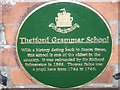
Thetford Grammar School
Thetford Grammar School can trace its origin back to Saxon times and has a continuous list of headmasters from the 12th century - an era when Thetford was a very important place. The school became co-educational in 1975 when it merged with the nearby Girls' Grammar School; it subsequently became an independent school in 1981.
Image: © Stephen McKay
Taken: 25 Sep 2010
0.03 miles
6
![Thetford buildings [24]](https://s0.geograph.org.uk/geophotos/06/71/52/6715248_93f25879_120x120.jpg)
Thetford buildings [24]
School House at number 19 Bridge Street is part of Thetford Grammar School. Built in 1880 of knapped flint with red brick dressings. Listed, grade II, with details at: https://historicengland.org.uk/listing/the-list/list-entry/1195951
Thetford Grammar School is an independent co-educational school which might date back to the 7th century. Part of the school is built on the site of a thirteenth-century Dominican Friary.
Once the ancient capital of East Anglia, Thetford is a market town established at a crossing of the River Little Ouse. A major centre of Boudica’s Iceni tribe with an Iron Age fort. Later came a Norman castle and an important priory. Thetford is the birthplace of 18th century radical Thomas Paine, whose thinking encouraged American independence and the abolition of slavery. After World War II, Thetford became an "overspill town", taking people from London.
Image: © Michael Dibb
Taken: 8 Sep 2020
0.03 miles
7
![Thetford features [4]](https://s3.geograph.org.uk/geophotos/06/71/52/6715263_1b8bd6df_120x120.jpg)
Thetford features [4]
The boundary wall in flint with ashlar dressings and cast iron gates to Thetford Grammar School probably date to 1877. Listed, grade II, with details at: https://historicengland.org.uk/listing/the-list/list-entry/1279699
Thetford Grammar School is an independent co-educational school which might date back to the 7th century. Part of the school is built on the site of a thirteenth-century Dominican Friary.
Once the ancient capital of East Anglia, Thetford is a market town established at a crossing of the River Little Ouse. A major centre of Boudica’s Iceni tribe with an Iron Age fort. Later came a Norman castle and an important priory. Thetford is the birthplace of 18th century radical Thomas Paine, whose thinking encouraged American independence and the abolition of slavery. After World War II, Thetford became an "overspill town", taking people from London.
Image: © Michael Dibb
Taken: 8 Sep 2020
0.04 miles
9
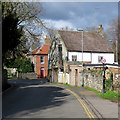
Thetford: on Old Bury Road
Sunlight, shadows and a roll-call of traditional Norfolk building materials.
Image: © John Sutton
Taken: 6 Mar 2020
0.04 miles
10
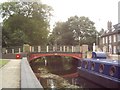
Bridge over the Little Ouse, Thetford
The blue narrowboat on the right is actually a floating restaurant.
Image: © Andy Dowland
Taken: 22 Aug 2005
0.04 miles