
IMAGES TAKEN NEAR TO
St. Martins Lane, THETFORD, IP24 2NQ
Introduction
This page details the photographs taken nearby to St. Martins Lane, IP24 2NQ by members of the Geograph project.
The Geograph project started in 2005 with the aim of publishing, organising and preserving representative images for every square kilometre of Great Britain, Ireland and the Isle of Man.

There are currently over 7.5m images from over14,400 individuals and you can help contribute to the project by visiting https://www.geograph.org.uk
Image Map
Images are licensed for reuse under creativecommons.org/licenses/by-sa/2.0
Notes
- Clicking on the map will re-center to the selected point.
- The higher the marker number, the further away the image location is from the centre of the postcode.
Image Listing (92 Images Found)
Images are licensed for reuse under creativecommons.org/licenses/by-sa/2.0
Image
Details
Distance
2
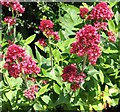
Red Valerian (Centranthus ruber)
Red Valerian is native to the Mediterranean and is reported to have been introduced to the UK before 1600. The colours of its flowers range from red, pink and white and a rare strain producing cream coloured flowers. The plant is fully naturalised and can be found growing in dry places, especially near the sea. It is also known as Jupiters Beard, Scarlet Lightning and Keys of Heaven.
Image: © Evelyn Simak
Taken: 23 May 2017
0.04 miles
3
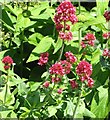
Red Valerian (Centranthus ruber)
Red Valerian is native to the Mediterranean and is reported to have been introduced to the UK before 1600. The colours of its flowers range from red, pink and white and a rare strain producing cream coloured flowers. The plant is fully naturalised and can be found growing in dry places, especially near the sea. It is also known as Jupiters Beard, Scarlet Lightning and Keys of Heaven.
Image: © Evelyn Simak
Taken: 23 May 2017
0.04 miles
4
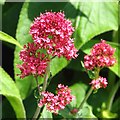
Red Valerian (Centranthus ruber)
Red Valerian is native to the Mediterranean and is reported to have been introduced to the UK before 1600. The colours of its flowers range from red, pink and white and a rare strain producing cream coloured flowers. The plant is fully naturalised and can be found growing in dry places, especially near the sea. It is also known as Jupiters Beard, Scarlet Lightning and Keys of Heaven.
Image: © Evelyn Simak
Taken: 23 May 2017
0.04 miles
5
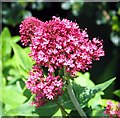
Red Valerian (Centranthus ruber)
Red Valerian is native to the Mediterranean and is reported to have been introduced to the UK before 1600. The colours of its flowers range from red, pink and white and a rare strain producing cream coloured flowers. The plant is fully naturalised and can be found growing in dry places, especially near the sea. It is also known as Jupiters Beard, Scarlet Lightning and Keys of Heaven.
Image: © Evelyn Simak
Taken: 23 May 2017
0.04 miles
6
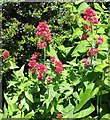
Red Valerian (Centranthus ruber)
Red Valerian is native to the Mediterranean and is reported to have been introduced to the UK before 1600. The colours of its flowers range from red, pink and white and a rare strain producing cream coloured flowers. The plant is fully naturalised and can be found growing in dry places, especially near the sea. It is also known as Jupiters Beard, Scarlet Lightning and Keys of Heaven.
Image: © Evelyn Simak
Taken: 23 May 2017
0.04 miles

8

Fritillaria spec
Fritillaria are native to Eurasia, North Africa, North America and the Mediterranian, and members of the lily family, comprising 100-odd species. The name originates from the Latin term for a dice-box (fritillus) and probably refers to the checkered pattern of the flowers of many species. Fritillaries are frequently characterised by nodding bell or cup-shaped flowers. Fritillaria extraces are used in traditional Chinese medicine called 'chuan bei mu'. Some species contain poisonous alkaloids and some may be deadly if ingested.
Image: © Evelyn Simak
Taken: 23 May 2017
0.05 miles
9
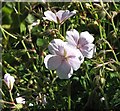
Cranesbill Geranium sanguineum
The genus Geranium comprises more than 400 species and many cultivated varieties, one of which being ‘Vision Light Pink’ which is depicted here. . Most geraniums are low growing, some are semi-evergreen and most have foliage that has a unique spicy scent.
Image: © Evelyn Simak
Taken: 23 May 2017
0.05 miles
10
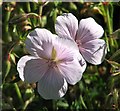
Cranesbill Geranium sanguineum
The genus Geranium comprises more than 400 species and many cultivated varieties, one of which being ‘Vision Light Pink’ which is depicted here. . Most geraniums are low growing, some are semi-evergreen and most have foliage that has a unique spicy scent.
Image: © Evelyn Simak
Taken: 23 May 2017
0.05 miles