
IMAGES TAKEN NEAR TO
Buccleuch Place, EDINBURGH, EH8 9JT
Introduction
This page details the photographs taken nearby to Buccleuch Place, EH8 9JT by members of the Geograph project.
The Geograph project started in 2005 with the aim of publishing, organising and preserving representative images for every square kilometre of Great Britain, Ireland and the Isle of Man.

There are currently over 7.5m images from over14,400 individuals and you can help contribute to the project by visiting https://www.geograph.org.uk
Image Map
Images are licensed for reuse under creativecommons.org/licenses/by-sa/2.0
Notes
- Clicking on the map will re-center to the selected point.
- The higher the marker number, the further away the image location is from the centre of the postcode.
Image Listing (769 Images Found)
Images are licensed for reuse under creativecommons.org/licenses/by-sa/2.0
Image
Details
Distance
1

Door, Buccleuch Place
Buccleuch Place is almost entirely occupied by the University of Edinburgh.
Image: © Richard Webb
Taken: 1 Apr 2021
0.01 miles
2

David Hume Tower
As seen from The Meadows.
Image: © Graeme Yuill
Taken: 5 Sep 2015
0.02 miles
3

Volkswagen overhead, Meadow Lane
An unusual and imaginative garage sign in a quiet back lane close to the Meadows.
Image: © kim traynor
Taken: 17 Oct 2006
0.02 miles
4
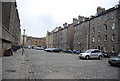
Buccleuch Place
Part of The University of Edinburgh.
Image: © N Chadwick
Taken: 21 Feb 2011
0.02 miles
5

Buccleuch Place
Looking east along the cobble street to Salisbury Crags. The university Business School and David Hume Tower are on the left and tenements, used by the university, on the right.
Image: © M J Richardson
Taken: 15 Feb 2017
0.02 miles
7

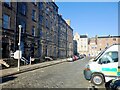
Buccleuch Place
Built around 1770, Buccleuch Place belonged to the first phase of Edinburgh's southward expansion, partly in competition with the Georgian New Town expanding to the North. It had its own Dancing Assembly (where steps now lead to the University's Hume Tower) and attracted some notables like Francis Jeffrey, co-founder of The Edinburgh Review in 1802. he lived at the south-west end of the street. The writer, Walter Scott, who lived round the corner in George Square, had his first dance here. In the late 1950s and early 1960s, the University began buying up properties here for use as departmental offices and tutoring rooms.
The Edinburgh advocate, Henry Cockburn, has left us this description of how the social gatherings of the middle classes at the assembly rooms were organised at the end of the eighteenth century.
"Martinet dowagers and venerable beaux acted as masters and mistresses of ceremonies, and made all the preliminary arrangements. No couple could dance unless each party was provided with a ticket prescribing the precise place in the precise dance. If there was no ticket, the gentleman, or the lady, was dealt with as an intruder, and turned out of the dance. If the ticket had marked upon it - say for a country dance, the figures 3.5; this meant that the holder was to place himself in the third dance, and fifth from the top; and if he was anywhere else, he was set right or excluded. And the partner's ticket must correspond. Woe on the poor girl who with ticket 2.7 was found opposite a youth marked 5.9! It was flirting without a licence, and looked very ill, and would probably be reported by the ticket director of that dance to the mother. Of course parties, or parents, who wished to secure dancing for themselves or those they had charge of, provided themselves with correct and corresponding vouchers before the ball day arrived. This could only be accomplished through a director; and the election of a pope sometimes required less jobbing. When parties chose to take their chance, they might do so; but still, though only obtained in the room, the written permission was necessary; and such a thing as a compact to dance, by a couple, without official authority, would have been an outrage that could scarcely be contemplated. Tea was sipped in side-rooms; and he was a careless beau who did not present his partner with an orange at the end of each dance; and the oranges and the tea, like everything else, were under exact and positive regulations. All this disappeared, and the very rooms were obliterated, as soon as the lately raised community secured its inevitable supremacy in the New Town."
See also Image and Image
Image: © kim traynor
Taken: 19 May 2009
0.03 miles
8
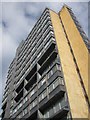
David Hume Tower
Designed by Robert Matthew Johnson-Marshall & Partners.
Image: © Graeme Yuill
Taken: 25 Sep 2010
0.03 miles
9

David Hume Tower
David Hume Tower with Adam Ferguson Building to left seen from Buccleuch Place
Image: © Graeme Yuill
Taken: 25 Sep 2010
0.03 miles
10

James Africanus Horton plaque, Buccleuch Place
Image: © kim traynor
Taken: 12 Jun 2009
0.03 miles