
IMAGES TAKEN NEAR TO
Morningside Road, EDINBURGH, EH10 4AZ
Introduction
This page details the photographs taken nearby to Morningside Road, EH10 4AZ by members of the Geograph project.
The Geograph project started in 2005 with the aim of publishing, organising and preserving representative images for every square kilometre of Great Britain, Ireland and the Isle of Man.

There are currently over 7.5m images from over14,400 individuals and you can help contribute to the project by visiting https://www.geograph.org.uk
Image Map
Images are licensed for reuse under creativecommons.org/licenses/by-sa/2.0
Notes
- Clicking on the map will re-center to the selected point.
- The higher the marker number, the further away the image location is from the centre of the postcode.
Image Listing (288 Images Found)
Images are licensed for reuse under creativecommons.org/licenses/by-sa/2.0
Image
Details
Distance
1

Santa doing the day job
Driving a No.5 Lothian Bus at Morningside, complete with intermittent handbell and Ho-Ho-Ho! And giving a lot of pleasure and amusement to passengers. Photographed with permission.
Image: © M J Richardson
Taken: 9 Dec 2015
0.01 miles
2

Morningside Road, Edinburgh
The A702 looking north. The coned-off areas are part of a large City Council project, with little discussion, to make roads and pavements safer for pedestrians and cyclists during and post-Covid-19. Much of the existing on-street parking is being abolished, so not entirely popular.
Image: © M J Richardson
Taken: 28 Jul 2020
0.02 miles
3

Bore Stone, Morningside Road
"All sic fensabill personis habill for weir betuyx the ages of sexte and sextene are to assemble on the burgh muir "in their best aray, bodin for weir under tynsal of lyfe, land and guid." -- James IV proclamation, 5th Sept. 1513
["All persons trained in arms for the defence of the homeland and dressed for war, between the ages of sixteen and sixty, are to assemble on the burgh muir wearing their best war equipment, or else their life, land and goods may be forfeited."]
For further explanation, see Image
Image: © kim traynor
Taken: 4 Apr 2007
0.02 miles
4

The Bore Stone, Morningside Road
The 'Bore Stone', or 'Hare Stone' (from Old Scots 'heir' meaning 'army'), is built into the western boundary wall of Morningside Parish Church. It is popularly believed to have held the royal standard of James IV when the Scottish army mustered on the burgh muir before marching to Flodden in 1513. Snag is, it has no hole-socket for a flagpole and reliable evidence indicates that the royal standard was actually raised Ellemford near Duns where the main Scottish Army assembled before marching into England.http://www.youtube.com/watch?v=0k7c6croM-I
An entry in the Burgh Records for 1586 refers to it as "...the Standand Stane toward Typperlin betuix the lands of Merchonstoun and the [Pow] burne." The 18thC historian William Maitland describes its original position as being on the eastern side of the road "almost opposite to the south-eastern corner of the Park-wall of Tipperlin Lone [now Albert Terrace]", which suggests that it may have been just a village boundary marker. It was placed in its present position by the owner of Greenhill, Sir John Stuart Forbes of Pitsligo, in 1852, doubtless under the strong influence of Walter Scott who was responsible in the first place for establishing the story attached to the stone.
As part of their feudal obligations as tenants of the Crown, the Clerks, as lairds of Penicuik, had to stand on a stone on the 'Burrowmore' and salute the King with three blasts of the horn whenever he went hunting in the area. Mrs Clerk had to come along, too, but could retain her lady-like composure by having to give only one blast. This obligation, the origin of which is lost in the mists of time, was renewed in a Royal charter of 1613, and even confirmed in another charter under Cromwell's rule in 1654. Some scholars have identified the act with the Buckstane near Fairmilehead, but, since that lay beyond the burgh muir, the Hare stane which stood on its edge has the better claim.
For the inscription on the plaque, see Image
Image: © kim traynor
Taken: 8 Apr 2011
0.02 miles

6

Morningside Road
Looking towards Church Hill.
Image: © kim traynor
Taken: 22 Sep 2011
0.02 miles
7
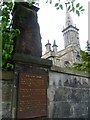
The Bore Stone, Morningside Road
The plaque reads:
The Bore Stone. In which the Royal Standard was pitched for the muster of the Scottish Army on the Burgh Muir before the battle of Flodden 1513. It long lay in the adjoining field, was then built into the wall near this spot, and finally placed here by Sir John Stuart Forbes of Pitsligo Bart. 1852.
Highest and midmost was descried
The Royal Banner floating wide,
The staff, a pine tree strong and straight,
Pitch'd steeply in a massive stone,
Which still in memory is shown,
Yet bent beneath the standard's weight.
Marmion*
[*epic poem about Flodden by Walter Scott, published in 1808]
But see Image
Image: © kim traynor
Taken: 15 Aug 2010
0.03 miles
8
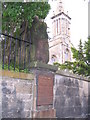
The Bore Stone
The plaque records that it is the stone “in which the Royal Standard was last pitched for the muster of the Scottish army on the Borough muir before the battle of Flodden 1513. It long lay in the adjoining field, was then built into the wall near this spot, and finally placed here by Sir John Stuart Forbes of Pitsligo Bart”. It has, however, been suggested that the stone was actually a simple boundary marker of a nearby estate. The church in the background is the former Morningside Parish Church, now part of Napier University.
Image: © M J Richardson
Taken: 28 Aug 2007
0.03 miles
9

Old Morningside Parish Church
The first church to be built in the village of Morningside opened in 1838 and closed in 1990 after amalgamating with the Braid Church. The land on which it was built was gifted by Sir John Stuart Forbes of nearby Greenhill House. Subscribers to the building fund included Alexander Falconar of Falcon Hall, Sir George Warrender of Bruntsfield House and 'the young gentlemen of Merchiston Academy'. It now belongs to Napier University whose Merchiston campus is close by.
Image: © kim traynor
Taken: 16 Aug 2010
0.03 miles
