
IMAGES TAKEN NEAR TO
Market Place, DURHAM, DH1 3NG
Introduction
This page details the photographs taken nearby to Market Place, DH1 3NG by members of the Geograph project.
The Geograph project started in 2005 with the aim of publishing, organising and preserving representative images for every square kilometre of Great Britain, Ireland and the Isle of Man.

There are currently over 7.5m images from over14,400 individuals and you can help contribute to the project by visiting https://www.geograph.org.uk
Image Map
Images are licensed for reuse under creativecommons.org/licenses/by-sa/2.0
Notes
- Clicking on the map will re-center to the selected point.
- The higher the marker number, the further away the image location is from the centre of the postcode.
Image Listing (1241 Images Found)
Images are licensed for reuse under creativecommons.org/licenses/by-sa/2.0
Image
Details
Distance
1
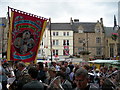
Market Place, Durham
This is the 2006 Durham Miners Gala. Many bands are marching through the city today, and many trade unions are represented.
The superb Kirkbymoorside Town Brass Band are immediately in front of us. They represent Blackhall Colliery. Here is their website.
http://www.ryedale.co.uk/Kirkbyband/kirkbyband.html
Image: © Danny P Robinson
Taken: 8 Jul 2006
0.00 miles
2
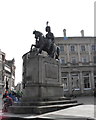
Market Place, Durham
Statue of the Marquis of Londonderry.
Image: © JThomas
Taken: 30 Mar 2015
0.01 miles
3
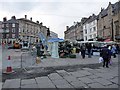
Changes at Durham Market Square
The whole square has recently been redesigned and pedestrianised. The statue of the third Marquess of Londonderry, local coal owner, has been resited at the top of the Market Square in Durham, and turned to face downhill.
Image: © Oliver Dixon
Taken: 18 Nov 2010
0.01 miles
4
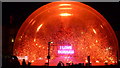
I Love Durham Snow Globe
From Lumiere 2019
Image: © Richard Cooke
Taken: 15 Nov 2019
0.01 miles
5
Third Marquess of Londonderry statue
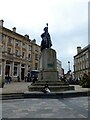
At the top end of the Market Square is the Grade II* listed https://historicengland.org.uk/listing/the-list/list-entry/1120630?section=official-list-entry statue of the Third Marquess of Londonderry. This equestrian statue is set within a paved area at the south end of the Market Place. It comprises a three-stepped sandstone base supporting a high, bow-end sandstone pedestal upon which stands a 4.7m tall copper statue of the Third Marquess of Londonderry, army officer and diplomat; this is an heroic size figure in hussar uniform on a rearing horse. The inscription, incised in capitals on a granite plaque, commemorates Charles William Vane Stewart, 3rd Marquess of Londonderry, Lord Lieutenant of Durham and founder of Seaham Harbour. It reads:
CHARLES WILLIAM VANE STEWART
3RD MARQUIS OF LONDONDERRY
1ST EARL VANE AND BARON STEWART
OF STEWARTS COURT K.G.G.C.B.
LORD LIEUTENANT COUNTY OF DURHAM
AND FOUNDER OF SEAHAM HARBOUR
GENERAL IN THE ARMY
BORN MAY 8TH 1778 DIED MARCH 6TH 1854.
A second metal plaque commemorates the restoration of the statue in 1952 and reads:
THIS PLAQUE WAS UNVEILED ON
THE 9TH DAY OF APRIL, 1952 BY THE
EIGHTH MARQUESS OF LONDONDERRY
TO COMMEMORATE THE RESTORATION
OF THE STATUE FROM FUNDS RAISED BY
THE CITY COUNCIL SOURCES
The statue was commissioned by The Third Marquess's widow Lady Frances Anne Vane-Tempest, to honour her husbands service to the county of Durham. By 1858 the memorial committee had received £2000 pounds and recommended a double life size equestrian statue by Milanese sculptor Raffaelle Monti (1818-1881), now resident in London. The statue was cast in c.1858 and it is considered to be the largest ever piece produced using the electro-plating process. The casting is thought to have been carried out by the London Firm Elkington & Co, who were awarded the first electro-plating patents in 1840, and by the mid-C19 were established as the leading silver and electroplate company in the world. This was a relatively new process in which pure copper was built up on moulds using electro plating which enabled greater detailing to be used.
The statue was unveiled in the Market Place, Durham on 2 December 1861 and those attending included Disraeli and Monti. It is believed that the inscription was added some years later. The statue was restored in London in 1951 and again in 2009-10, after which it was replaced 16m south of its original position in the Market Place.
Image: © Gerald England
Taken: 18 Oct 2022
0.01 miles
6
The man on a horse
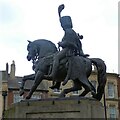
A close look at the statue of the Third Marquess of Londonderry Image The statue was commissioned by The Third Marquess's widow Lady Frances Anne Vane-Tempest, to honour her husbands service to the county of Durham. By 1858 the memorial committee had received £2000 pounds and recommended a double life size equestrian statue by Milanese sculptor Raffaelle Monti (1818-1881), now resident in London. The statue was cast in c.1858 and it is considered to be the largest ever piece produced using the electro-plating process. The casting is thought to have been carried out by the London Firm Elkington & Co, who were awarded the first electro-plating patents in 1840, and by the mid-C19 were established as the leading silver and electroplate company in the world. This was a relatively new process in which pure copper was built up on moulds using electro plating which enabled greater detailing to be used.
Image: © Gerald England
Taken: 18 Oct 2022
0.01 miles
7

Statue of the Marquis of Londonderry, Market Place, Durham
Natwest Bank behind.
Image: © JThomas
Taken: 9 May 2025
0.01 miles
8
Durham Market Place
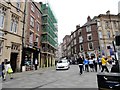
This is the centre of the city, looking up Saddler Street, on the left, which leads up to the cathedral. The shop in the centre is the very popular Bells Fish Restaurant.
Image: © Robert Graham
Taken: 2 Jun 2018
0.01 miles
9
Market Place, Durham
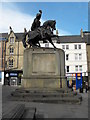
Statue of the Marquis of Londonderry.
Image: © JThomas
Taken: 30 Mar 2015
0.01 miles
10
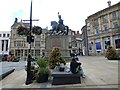
Third Marquess of Londonderry statue in the Market Place
At the top end of the Market Square is the Grade II* listed https://historicengland.org.uk/listing/the-list/list-entry/1120630?section=official-list-entry statue of the Third Marquess of Londonderry. This equestrian statue is set within a paved area at the south end of the Market Place. It comprises a three-stepped sandstone base supporting a high, bow-end sandstone pedestal upon which stands a 4.7m tall copper statue of the Third Marquess of Londonderry, army officer and diplomat; this is an heroic size figure in hussar uniform on a rearing horse. The inscription, incised in capitals on a granite plaque, commemorates Charles William Vane Stewart, 3rd Marquess of Londonderry, Lord Lieutenant of Durham and founder of Seaham Harbour. It reads:
CHARLES WILLIAM VANE STEWART
3RD MARQUIS OF LONDONDERRY
1ST EARL VANE AND BARON STEWART
OF STEWARTS COURT K.G.G.C.B.
LORD LIEUTENANT COUNTY OF DURHAM
AND FOUNDER OF SEAHAM HARBOUR
GENERAL IN THE ARMY
BORN MAY 8TH 1778 DIED MARCH 6TH 1854.
The statue was commissioned by The Third Marquess's widow Lady Frances Anne Vane-Tempest, to honour her husbands service to the county of Durham. By 1858 the memorial committee had received £2000 pounds and recommended a double life size equestrian statue by Milanese sculptor Raffaelle Monti (1818-1881), now resident in London. The statue was cast in c.1858 and it is considered to be the largest ever piece produced using the electro-plating process. The casting is thought to have been carried out by the London Firm Elkington & Co, who were awarded the first electro-plating patents in 1840, and by the mid-C19 were established as the leading silver and electroplate company in the world. This was a relatively new process in which pure copper was built up on moulds using electro plating which enabled greater detailing to be used.
The statue was unveiled in the Market Place, Durham on 2 December 1861 and those attending included Disraeli and Monti. It is believed that the inscription was added some years later. The statue was restored in London in 1951 and again in 2009-10, after which it was replaced 16m south of its original position in the Market Place.
In the background between the Grade II listed https://historicengland.org.uk/listing/the-list/list-entry/1323244?section=official-list-entry Barclays Bank on the left and the Grade II listed https://historicengland.org.uk/listing/the-list/list-entry/1160136?section=official-list-entry NatWest bank on the right, Saddler Street leads to the Cathedral and the Castle.
Image: © Gerald England
Taken: 18 Oct 2022
0.01 miles