
IMAGES TAKEN NEAR TO
Station Road, DERBY, DE74 2UU
Introduction
This page details the photographs taken nearby to Station Road, DE74 2UU by members of the Geograph project.
The Geograph project started in 2005 with the aim of publishing, organising and preserving representative images for every square kilometre of Great Britain, Ireland and the Isle of Man.

There are currently over 7.5m images from over14,400 individuals and you can help contribute to the project by visiting https://www.geograph.org.uk
Image Map
Images are licensed for reuse under creativecommons.org/licenses/by-sa/2.0
Notes
- Clicking on the map will re-center to the selected point.
- The higher the marker number, the further away the image location is from the centre of the postcode.
Image Listing (47 Images Found)
Images are licensed for reuse under creativecommons.org/licenses/by-sa/2.0
Image
Details
Distance
1
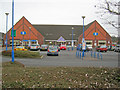
Donington Castle Co-op
Medium-sized supermarket off Station Road.
Image: © Trevor Rickard
Taken: 23 Jan 2011
0.06 miles
2
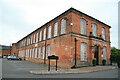
Donington Mill, Castle Donington
Alan Murray-Rust writes: - Former silk mill, the Listing description states "'Recently erected' 1877 by John Watson and Son, silk throwsters (Kelly's Directory, 1877)", now converted for small business use. Listed Grade II.
Image: © Chris Allen
Taken: 18 May 2013
0.07 miles
3
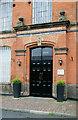
Donington Mill, Castle Donington
According to Alan Murray-Rust: - Former silk mill, the Listing description states "'Recently erected' 1877 by John Watson and Son, silk throwsters (Kelly's Directory, 1877)", now converted for small business use. Listed Grade II.
Now the Mill House Business Centre.
Image: © Chris Allen
Taken: 18 May 2013
0.07 miles
4
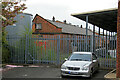
Industrial premises, Castle Donington
The building to the left are, I believe, a former textile mill in this Leicestershire town. Since this picture was taken the open canopy on the right has had wall added and a green building added beyond the gates that might be a modern boiler house.
Image: © Chris Allen
Taken: 18 May 2013
0.07 miles
5
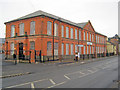
Donington Mill
Situated on the east side of Station Road. Castle Donington, like so many villages west of Nottingham, has a history of lace, silk and hosiery manufacture. The local population trebled between 1800 and 1840, by which time there were 110 small frame work knitting factories around the village.
Donington Mill was a silk mill, built around 1870 by John Watson & Son, major Nottingham textile manufactures. It is constructed of brick with very large cast iron windows to provide the workers inside with as much light as possible. Note the buttress on the right of the second window at this end, added in the early 20th century to strengthen the building. Inside, cast iron columns hold up the roof and wooden floors.
Conditions at this mill were very hard and much child labour was employed in the 1870s. The Factories Act of 1847 had limited work in textile mills for children under 18 years old and women were limited to 58 hours per week and 10 hours per day, but the law excluded lace and silk production. There were great tensions between education professionals and the mill owners, who were happy to use children as young as five and have a minimum 12-hour working day. It took the Factory Act of 1878 to apply standard factory worker hours to all trades. Even then, conditions were tough, with women limited to 56 hours per week, no child under the age of 10 to be employed and those between 10 and 14 employed for half days only. At least education was made compulsory for those under 10 for the first time.
The mill has been neatly converted into The Mill House Business Centre, providing office space for several small firms.
Image: © Trevor Rickard
Taken: 23 Jan 2011
0.07 miles
6
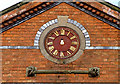
Handless clock
On Donington Mill.
Reading the description on Image it is sad to think that this clock, which may seem quite attractive to us now, once so brutally ruled people's lives.
The building is Grade II listed with List entry Number: 1074162 https://historicengland.org.uk/listing/the-list/list-entry/1074162 .
Image: © David Lally
Taken: 18 May 2013
0.07 miles
7
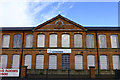
Donington Mill
See Image for an excellent history of this building.
It has a Grade II listing List entry Number: 1074162 https://historicengland.org.uk/listing/the-list/list-entry/1074162 .
Image: © David Lally
Taken: 18 May 2013
0.07 miles
8
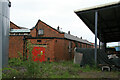
Industrial premises, Castle Donington
I believe the building on the left is a former textile mill in this Leicestershire town. Since this was take the canopy on the right has had walls added and a green building has been erected in the foreground that appears to be possibly a modular boiler house.
Image: © Chris Allen
Taken: 18 May 2013
0.07 miles
9
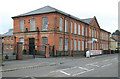
Donington Mill
Trevor Rickard's description (for Image) is as follows -
Situated on the east side of Station Road. Castle Donington, like so many villages west of Nottingham, has a history of lace, silk and hosiery manufacture. The local population trebled between 1800 and 1840, by which time there were 110 small frame work knitting factories around the village.
Donington Mill was a silk mill, built around 1870 by John Watson & Son, major Nottingham textile manufactures. It is constructed of brick with very large cast iron windows to provide the workers inside with as much light as possible. Note the buttress on the right of the second window at this end, added in the early 20th century to strengthen the building. Inside, cast iron columns hold up the roof and wooden floors.
Image: © Chris Allen
Taken: 18 May 2013
0.08 miles
10
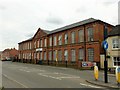
Donington Mill, Station Road, Castle Donington
Former silk mill, the Listing description states "'Recently erected' 1877 by John Watson and Son, silk throwsters (Kelly's Directory, 1877)", now converted for small business use. Listed Grade II.
Image: © Alan Murray-Rust
Taken: 18 Jun 2019
0.08 miles