
IMAGES TAKEN NEAR TO
Castle Place, MONTROSE, DD10 8AL
Introduction
This page details the photographs taken nearby to Castle Place, DD10 8AL by members of the Geograph project.
The Geograph project started in 2005 with the aim of publishing, organising and preserving representative images for every square kilometre of Great Britain, Ireland and the Isle of Man.

There are currently over 7.5m images from over14,400 individuals and you can help contribute to the project by visiting https://www.geograph.org.uk
Image Map
Images are licensed for reuse under creativecommons.org/licenses/by-sa/2.0
Notes
- Clicking on the map will re-center to the selected point.
- The higher the marker number, the further away the image location is from the centre of the postcode.
Image Listing (352 Images Found)
Images are licensed for reuse under creativecommons.org/licenses/by-sa/2.0
Image
Details
Distance
1
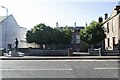
Castle Stead, Castle Place, Montrose, Angus
Castle Stead is reputedly the birthplace of James Graham, (1612 - 21 May 1650), the 1st Marquess of Montrose. His diaries record that he bought two golf clubs ‘in Montrois’ for 24 shillings to play golf with his brother in law, Sir John Colquhoun on the 9th November 1629, which was the day before his wedding at Kinnaird Castle. Both James Graham and his bride, Magdalena Carnegie, were aged 17 when they married.
James Graham, 1st Marquess of Montrose is known as the Great Montrose. As a man of many facets and abilities, he was a nobleman, a poet, a soldier and later viceroy and captain general of Scotland. He was a brilliant, battle commander and tactician and he fought a number of spectacular campaigns which identified him as one of the great military commanders of his age and perhaps of any age. At first, he joined the Covenanters in the Wars of the Three Kingdoms, but he subsequently changed sides and supported the Royalists and King Charles I. Ultimately, he shared the same gruesome fate as King Charles 1 by being decapitated. After the Restoration, King Charles II paid for a lavish funeral in 1661, when Montrose’s reputation was changed from traitor to that of martyr.
Around 1810, Nicholas Carnegie bought Castle Stead from James Graham, the 4th Duke of Montrose, (1799 – 1874), who was the great-grandson of the Great Montrose. Nicholas Carnegie, HEICS, had a tenuous family connection to David Scott, Chairman of the East India Company through his mother, Susan Carnegie. This slight connection was critical to his military career in India where he gained the rank of Major-General and commanded the Bengal Artillery.
A plaque on one of the entrance pillars outside Castle Stead informs the reader that this was the site of the 12th century Montrose Castle which was destroyed in 1297. The assertion that this is the site of Montrose Castle is disputed, however, as there is little or no archaeological evidence to support this view. At present, the Category B Listed Building of Castle Stead, at 3 and 4 Castle Place, serves as Montrose Job Centre. In addition to Castle Stead, the photo also shows the nearby statue of the Great Montrose. This statue was unveiled by James Graham, 8th Duke of Montrose, on the 4th August 2000, to mark the 350th anniversary of the execution of the 1st Marquess, in 1650, at the Mercat Cross in Edinburgh.
Image: © Adrian Diack
Taken: 29 Jun 2023
0.01 miles
3
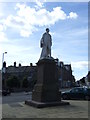
Sir Robert Peel statue in Montrose
Father of Britain's Police Force (Bobbies). This 1854 statue by Alexander Ritchie [http://www.glasgowsculpture.com/pg_biography.php?sub=ritchie_ah ] was erected in Montrose in 1855 to honour his political achievments.
Image: © Stanley Howe
Taken: 31 Jul 2007
0.02 miles
4
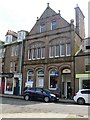
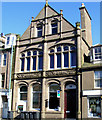
Castle Place building
This delightful bank building dates from 1900 and is listed, category B, with details at: http://www.britishlistedbuildings.co.uk/sc-38098-14-and-15-castle-place-#.V4J0mDU5t8E
Image: © Michael Dibb
Taken: 13 Jun 2016
0.02 miles
5
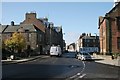
Castle Place, Montrose
The buildings on the left are all Category B listed. The red sandstone building on the right is the Category A listed [http://portal.historicenvironment.scot/designation/LB38051] Public Library [http://www.geograph.org.uk/photo/1061740].
Image: © Richard Sutcliffe
Taken: 28 Sep 2017
0.02 miles
6
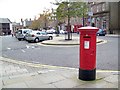
Postbox, Montrose
An Edward VII reign postbox on the High Street.
Image: © Maigheach-gheal
Taken: 5 Oct 2009
0.02 miles
7
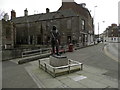
Statue of James Graham, 1st Marquis of Montrose
James Graham, 1st Marquis of Montrose (25 October 1612 – 21 May 1650) was a Scottish nobleman and soldier. He initially joined the Covenanters in the Wars of the Three Kingdoms, but subsequently supported King Charles I during the English Civil War. He fought a civil war in Scotland for the King from 1644 to 1646 and once more in 1650. He was execute at The Mercat Cross, Edinburgh in 1650. He was known in Scotland as "The Great Montrose".
Image: © Douglas Nelson
Taken: 21 Mar 2016
0.02 miles
8
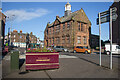
Montrose Library, High Street, Montrose, Angus
Montrose Library is located in an A-listed, Carnegie funded, Building on the High Street in Montrose. In 1901, Andrew Carnegie responded to a request to provide funds for a public library in Montrose with the words “I should be very glad to comply with your suggestion and consider it a privilege if Montrose will adopt the Free Libraries Act and provide a suitable site. I will be glad to provide money for the building.” In 2018, it received a £1 million refurbishment which provided it with “flexible, community focused spaces” and this made it the first of its kind in Scotland.
Image: © Adrian Diack
Taken: 29 Jun 2023
0.02 miles
9
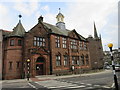
Montrose Library
The Carnegie Library at Montrose, from the southern end of the High Street.
Image: © Scott Cormie
Taken: 28 Aug 2016
0.03 miles
10
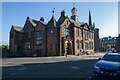
Montrose Library site; the birthplace of Robert Brown, Angus
The accompanying photo shows a north-northeast view of Montrose Library on Montrose High Street. The site of this building was formerly the cross shaped house where the renowned Montrose botanist Robert Brown was born. In the first half of the 19th century, he became the most celebrated botanist in the world and in his memory there is a bust of him in the entrance to the library. This heavy, bronze bust which was donated by his relative Miss Hope Paton and unveiled on the 18th October 1895 was originally placed on an ornamental shelf in the house where Brown was born but it now sits on the left side of the entrance to the library where it may be thought to greet all who enter the building.
Robert Brown (21 December 1773 – 10 June 1858) was the son of James Brown a minister in the Scottish Episcopal Church and his mother Helen Brown (née Taylor) who was the daughter of a Presbyterian minister. Their home was the manse of the Episcopal Church in Montrose and Rev. James Brown preached in the house owing to the fact that he would not pray for King George III. James Brown’s father was a Forfarshire (Angus) farmer at Bolshan who was killed at Culloden while fighting for Prince Charlie. Young Robert attended what is now Montrose Academy until the age of 14 before proceeding to study medicine at Marischal College in Aberdeen and then from 1790 at Edinburgh University. In June 1795, he was appointed as a Surgeon’s Mate in the British army and he served in Northern Ireland. However, he is better known as Robert Brown FRSE, FRS, FLS, MWS, and he is best remembered as a botanist and palaeobotanist who made important contributions to botany through his pioneering use of the microscope. His contributions and discoveries include one of the earliest descriptions of the cell nucleus and cytoplasmic streaming; early work on the plant pollination and fertilisation including being the first to recognise the difference between gymnosperms (conifers and their allies) and angiosperms (flowering plants); some of the earliest studies in palynology; numerous contributions to plant taxonomy and the discovery of Brownian motion.
Although a man of quiet manners, Robert Brown was adventurous and when an expedition was organised to survey the coasts of New Holland (Australia) under Captain Matthew Flinders, he was at a great advantage for the appointment of botanist as he was recommended to the Admiralty by Sir Joseph Banks. They sailed from Spithead on board the ship HMS Investigator for Australia at 11.00am on the 18th July 1801 and made an historic voyage in that they were the first to circumnavigate the coast of that great island. Brown remained in Australia collecting plants until his return in October 1805. He returned with about 4,000 species of plants, most of which were new to science. A few months after his arrival, he was appointed Librarian to the Linnean Society and in the following years he devoted himself in a painstakingly accurate way to the study of Australian plants.
In 1811, Mr Brown was elected a Fellow of the Royal Society. Sir Joseph Banks bequeathed his herbarium and library to the British Museum, but reserved the right to Mr Brown the free use of both for life. After negotiations with the Trustees, Mr Brown transferred the collections to them and he was appointed Keeper of its newly formed botanical department in 1827. Mr Brown was President of the Linnean Society from 1849 – 1853; he was a Fellow of the principal scientific societies of the world, and he had the degree of D.C.L. conferred on him by the University of Oxford. The Copley Medal, which is the oldest and most prestigious award in the United Kingdom awarded annually by the Royal Society of London “for outstanding achievements in research in any branch of science” was presented to Brown in 1839. Baron Humboldt styled him as the “facile Princeps Botanicorum” and Bonaparte wanted to make him a Count.
In addition to the moss (Tetrodontium brownianum) a species that he discovered growing at Roslin near Edinburgh while still a student, Brown’s name is commemorated in the Australian herb genus Brunonia and also numerous Australian species including Eucalyptus brownie and Banksia brownii. In addition to this, a number of places are also named after him including Brown’s River south of Hobart, Mount Brown and Point Brown in South Australia and Mount Brown in British Columbia, Canada.
On the 26th January 1792, Robert Brown read his first botanical paper to the Edinburgh Natural History Society on the subject of “The Botanical History of Angus.” In this paper he referred to local plants and noted, for example, that Eryngium maritimum, or sea holly grows plentifully on the sandy beach near Montrose….” Although he lived in Sir Joseph Bank’s house at 17 Dean Street, Soho Square, London, he never lost interest in the plants of Scotland and he often returned to Montrose; aged 80, in 1835, he climbed Lochnagar, a mountain on which he had botanized sixty years earlier.
Dr Brown was a tall, imposing figure who possessed a dry wit. He was kind, generous and unassuming in manner and he particularly enjoyed the company of close friends such as members of the Scottish MacLeay family and Dr Francis Boott. He had few near relatives and he never married. He died in Sir Joseph Bank’s house at 17 Dean Street, Soho Square, and he was buried in Kensal Green Cemetery, London.
Image: © Adrian Diack
Taken: 29 Jun 2023
0.03 miles