
Old Headington, Oxford
Introduction
The photograph on this page of Old Headington, Oxford by David Hallam-Jones as part of the Geograph project.
The Geograph project started in 2005 with the aim of publishing, organising and preserving representative images for every square kilometre of Great Britain, Ireland and the Isle of Man.

There are currently over 7.5m images from over 14,400 individuals and you can help contribute to the project by visiting https://www.geograph.org.uk
Old Headington, Oxford
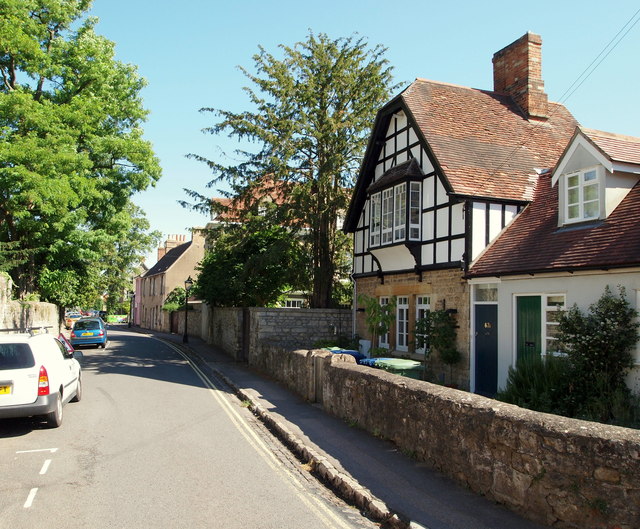
Image: © David Hallam-Jones Taken: 1 Aug 2013
This is approximately halfway along Old High Street, with the main village crossroads another 2-3 minute walk away in the distance. London Road, i.e. the A420 lies 3-4 minutes walk behind the photographer. This faux-Tudor embellished private house is still called "The British Workman". The British Workman movement began in the 1860s in the north of England with the aim of establishing alcohol-free public places in which working men could socialise. Soon there were numerous British Workman temperance hotels, tea/coffee houses and clubs throughout the country. The Church of England Temperance Society was set up in Headington in 1874 by Lewis S. Tuckwell, then curate of the nearby St Andrew's Church, and in 1876 Colonel Desborough of The Priory converted No.9, The Croft (where a subscription reading room had been founded in 1858) into a British Workman establishment. This rented cottage, however, proved to be too small to meet the demand and a Mrs Ballachey of Bury Knowle House (now housing the public library) donated some land and a Miss Mary A. Nichol of Jessamine Cottage (a.k.a. Jesmond Cottage) in Old High Street financed the building of this New British Workman building in 1880. In 1883 a large hall capable of holding 200 people was added to the rear of it where dances and whist drives were held. In 1891 a gym was also added for the young men of the parish. In addition, since many of the other properties in the village had no indoor plumbing, there were facilities for “weekly baths” here until 1946. A soup kitchen and baby clinic facilities were also provided there in the past.
Images are licensed for reuse under creativecommons.org/licenses/by-sa/2.0
Image Location

Latitude
51.762814
Longitude
-1.210986