
Sign for the Prince of Wales
Introduction
The photograph on this page of Sign for the Prince of Wales by Maigheach-gheal as part of the Geograph project.
The Geograph project started in 2005 with the aim of publishing, organising and preserving representative images for every square kilometre of Great Britain, Ireland and the Isle of Man.

There are currently over 7.5m images from over 14,400 individuals and you can help contribute to the project by visiting https://www.geograph.org.uk
Sign for the Prince of Wales
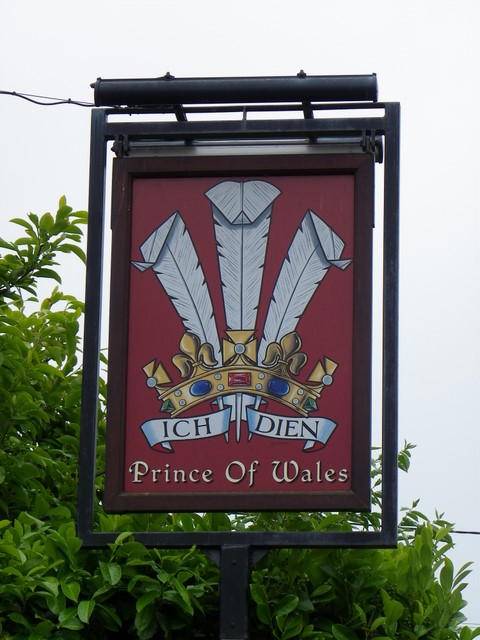
Image: © Maigheach-gheal Taken: 5 Jun 2011
Tradition says that this sign, which is sometimes seen as the Prince of Wales's Feathers, Plume of Feathers, Prince's Arms and other names, comes from the Black Prince. In 1346 he defeated the King of Bohemia, John of Luxemburg, and assumed his crest and motto, 'Hou Moet, Ich Dien' which was the subject of some controversy as to its meaning. Loosely translated, however, it apparently meant 'Keep courage, I am your companion in arms and I serve with you.' The Ich Dien and three ostrich plumes are still the crest of the Prince of Wales. This title derives from the time of Edward I, who obtained the submission of Wales in 1284, and is conferred on the heir apparent to the throne. But calling it the Prince of Wales's feathers is a misnomer because it is the badge of the heir apparent whether or not he holds the title Prince of Wales. Some say it is a sign which came from poor painting and that it is really a debased version of a Fleur de Lys, the lilies of France.
Images are licensed for reuse under creativecommons.org/licenses/by-sa/2.0
Image Location

Latitude
50.92387
Longitude
-1.188336