
All (or as much as) you ever need to know about the Innocent Railway
Introduction
The photograph on this page of All (or as much as) you ever need to know about the Innocent Railway by kim traynor as part of the Geograph project.
The Geograph project started in 2005 with the aim of publishing, organising and preserving representative images for every square kilometre of Great Britain, Ireland and the Isle of Man.

There are currently over 7.5m images from over 14,400 individuals and you can help contribute to the project by visiting https://www.geograph.org.uk
All (or as much as) you ever need to know about the Innocent Railway
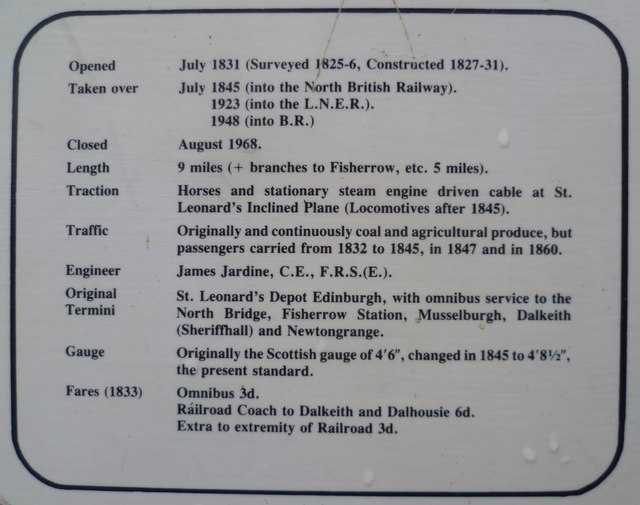
Image: © kim traynor Taken: 18 Feb 2011
Information plaque on the cycle path near the entrance from Duddingston Road West. The line's nickname derives from Dr. Robert Chambers referring to "the innocence of the railway" when commenting on its unblemished safety record. "Railways—Few undertakings have contributed more to the commerce, convenience, and health of the surrounding neighbourhood, than the Edinburgh and Dalkeith Railway. The company was incorporated by Act of Parliament in 1826;—the work was begun in 1827;—and the main line between Edinburgh and Dalhousie, a distance of about eight miles, and the Fisherrow branch, about one mile, were opened in 1831. The expense was about L.130,000. This railway is worked by horses, and was intended for the conveyance of coal and other minerals, farm-produce, manure, &c. Passengers were not thought of in the original estimate, though they have become the chief source of profit. The average amount of tonnage conveyed by this railway is about 120,000 per annum; and the passengers amount to about 300,000. The Leith branch, which is a separate concern, and belongs to a different set of subscribers, was opened in 1835. The Dalkeith branch, which is the exclusive property of His Grace the Duke of Buccleuch, and was intended solely for the benefit of that town, was opened in the end of 1838. However desirable, it seemed, for some time, impracticable to extend this branch to His Grace's coal-fields, in the neighbourhood of Cowden. But these obstacles were soon surmounted;—the intervening properties were purchased, and a magnificent viaduct has been erected at great expense over the vale of the South Esk. This bridge consists of six arches;—the two arches at the extremities of the bridge are each of 110 feet span;—and the four intermediate arches are each of 120 feet span. The arches are built of the best Dantzick timber, and rest upon stone piers of hewn ashlar. The height, from the ordinary water-mark to the road-way, is 78 feet;—the whole length is 830 feet;—and the entire width of road-way between the railings is 14 feet. The whole structure is of the most tasteful architecture, and imparts a highly picturesque character to the surrounding scenery." -- New Statistical Account, 1845 Image
Images are licensed for reuse under creativecommons.org/licenses/by-sa/2.0
Image Location

Latitude
55.936631
Longitude
-3.144522