
Welcome to Beverley Information Board (1)
Introduction
The photograph on this page of Welcome to Beverley Information Board (1) by David Hillas as part of the Geograph project.
The Geograph project started in 2005 with the aim of publishing, organising and preserving representative images for every square kilometre of Great Britain, Ireland and the Isle of Man.

There are currently over 7.5m images from over 14,400 individuals and you can help contribute to the project by visiting https://www.geograph.org.uk
Welcome to Beverley Information Board (1)
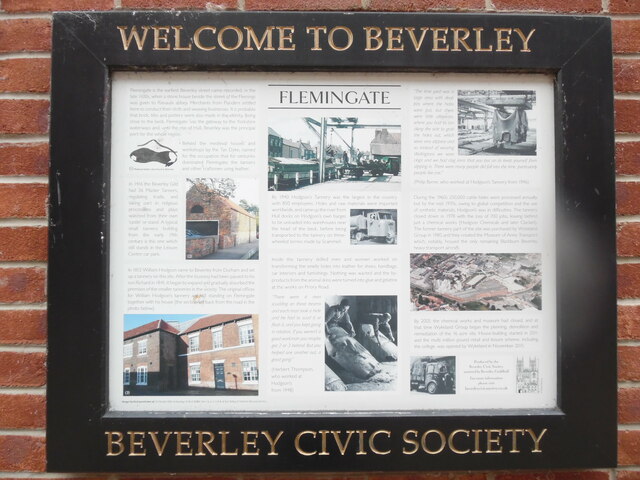
Image: © David Hillas Taken: 25 Jul 2022
This information board in Flemingate Centre HU17 0NQ has been erected by the Beverley Civic Society assisted by Beverley Guildhall. It has the following wording: FLEMINGATE Left column Flemingate is the earliest Beverley street name recorded, in the late 1100s, when a stone house beside the street of the Flemings was given to Rievaulx abbey. Merchants from Flanders settled here to conduct their cloth and weaving businesses. It is probable that brick, tiles and pottery were also made in the vicinity. Being close to the beck, Flemingate was the gateway to the Yorkshire waterways and, until the rise of Hull, Beverley was the principal port for the whole region. Image (1) Medieval leather shoe found in Beverley Behind the medieval houses and workshops lay Tan Dyke, named for the occupation that for centuries dominated Flemingate; the tanners and other craftsmen using leather. In 1416 the Beverley Gild had 26 Master Tanners, regulating trade, and taking part in religious processions and plays watched from their own 'castle' or stand. A typical small tannery building from the early 19th century is this one which still stands in the Leisure Centre car park. Image (2) In 1812 William Hodgson came to Beverley from Durham and set up a tannery on this site. After the business had been passed to his son Richard in 1841, it began to expand and gradually absorbed the premises of the smaller tanneries in the vicinity. The original offices for William Hodgson's tannery are still standing on Flemingate together with his house (the section set back from the road in the photo below). Image (3) Middle column Image (4) By 1940 Hodgson's Tannery was the largest in the country with 850 employees. Hides and raw materials were imported worldwide, and came up the river from Hull docks on Hodgson's own barges to be uploaded into warehouses near the head of the beck, before being transported to the tannery on three-wheeled lorries made by Scammell. Image (5) Inside the tannery skilled men and women worked on transforming the smelly hides into leather for shoes, handbags, car interiors and furnishings. Nothing was wasted and the by-products from the animal skins were turned into glue and gelatine at the works on Priory Road. "There were 6 men scudding on those beams and each man took a hide and he had to scud it or flesh it, and you kept going in rotation. If you weren't a good workman you maybe got 2 or 3 behind. But you helped one another out, a good gang". (Herbert Thompson, who worked at Hodgson's from 1948). Image (6) Right column "The lime yard was a large area with deep pits where the hides were put, but there were little alleyways, where you had to run along the side to grab the hides out, which were very slippery and so instead of wearing Wellingtons we wore clogs and we had clog irons that you put on to keep yourself from slipping in. There were many people did fall into the lime, particularly people like me". (Philip Byrne, who worked at Hodgson's Tannery from 1946) Image (7) During the 1960s 250,000 cattle hides were processed annually but by the mid 1970s, owing to global competition and the use of synthetic materials, Hodgson's was in difficulties. The tannery closed down in 1978 with the loss of 700 jobs, leaving behind just a chemical works (Hodgson Chemicals and later Clariant). The former tannery part of the site was purchased by Wykeland Group in 1980 and they created the Museum of Army Transport which notably, housed the only remaining Blackburn Beverley heavy transport aircraft. Image (8) By 2005 the chemical works and museum had closed, and at that time Wykeland Group began the planning, demolition and remediation of the 16 acre site. House-building started in 2011 and the multi million pound retail and leisure scheme, including the college, was opened by Wykeland in November 2015. Image (9)
Images are licensed for reuse under creativecommons.org/licenses/by-sa/2.0
Image Location

Latitude
53.839898
Longitude
-0.420182