
The Biggest Grave in The Churchyard
Introduction
The photograph on this page of The Biggest Grave in The Churchyard by Ian Dodds as part of the Geograph project.
The Geograph project started in 2005 with the aim of publishing, organising and preserving representative images for every square kilometre of Great Britain, Ireland and the Isle of Man.

There are currently over 7.5m images from over 14,400 individuals and you can help contribute to the project by visiting https://www.geograph.org.uk
The Biggest Grave in The Churchyard
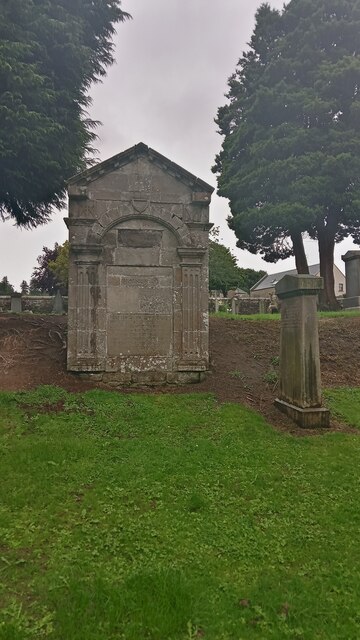
Image: © Ian Dodds Taken: 21 Aug 2021
From this angle it might appear that this is the front of a mausoleum; it is in fact just an enormous gravestone. There were churches on this site for hundreds of years before the present one was built in the 1700s and this grave dates from the 1630s, a tribute to Matthew Lichton (or Leighton or Letham, depending on the source), the church's second post-Reformation minister. The gravestone fell down in the 1880s while a wall was getting moved - the rebuilding is noted on the dark stone in the centre. The Latin inscription at the bottom is really just a long-winded way of saying that he was a good hard-working sort who has now gone to heaven. The Reformation occurred in the early 1500s when some members of the Catholic Church, unhappy with certain aspects of it, broke away to form their own branch of Christianity, Protestantism. Obviously there are thousand word books covering this subject, none of which I have read! But in a nutshell, it all started in what is now Germany when a priest called Martin Luther published a few essays about what changes he thought the church should make, then gained some followers and got in trouble with the authorities, and ultimately The Pope. Things then snowballed. A law was made banning people from following his teachings, called 'The Edict of Worms' (Worms is just the name of a German town). His followers then issued the 'Letter of Protestation' in response, and a new church was born, taking its name from the title. An interesting fact about Martin Luther is that he ended up marrying one of several nuns he organised to have smuggled out of their convent in herring barrels. It is not stated anywhere whether he knew the nun before she emerged from the barrel or not.
Images are licensed for reuse under creativecommons.org/licenses/by-sa/2.0
Image Location

Latitude
55.894841
Longitude
-3.307683