
RAF / USAAF Ridgewell Memorial
Introduction
The photograph on this page of RAF / USAAF Ridgewell Memorial by Adrian S Pye as part of the Geograph project.
The Geograph project started in 2005 with the aim of publishing, organising and preserving representative images for every square kilometre of Great Britain, Ireland and the Isle of Man.

There are currently over 7.5m images from over 14,400 individuals and you can help contribute to the project by visiting https://www.geograph.org.uk
RAF / USAAF Ridgewell Memorial
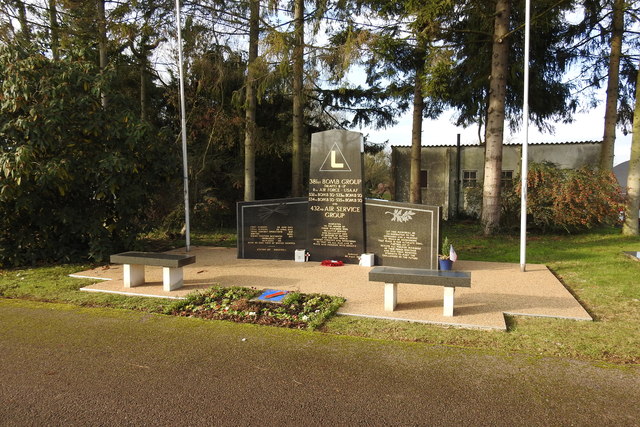
Image: © Adrian S Pye Taken: 3 Dec 2019
RAF Ridgewell was an early example of stations completed to Class A heavy bomber airfield design for the RAF, and had three intersecting runways of 6,500 ft each in length, thirty-six hardstands, two T-2 hangars and accommodation for 2,900 men in temporary buildings. RAF Ridgewell was the only long-term heavy bomber airfield of the Eighth Air Force in Essex. For United States Army Air Forces (USAAF) use, the number of hardstandings was increased to the fifty required by a US bomb group. The station was part of the 1st Combat Wing establishment of the 1st Division and was the furthest east of its thirteen heavy bomber stations. It was assigned USAAF designation Station 167, station code "RD". The tail identification code was a capital letter "L" in a triangle as depicted on the memorial. The 381st BG (H) flew four squadrons of B-17 Flying Fortress's supported by the 432nd Air Support Group attending to the airworthiness of the aircraft. After the war, RAF Ridgewell was used for bomb storage from 15 July 1945 to 31 March 1957. It was then disposed of and sold.
Images are licensed for reuse under creativecommons.org/licenses/by-sa/2.0
Image Location

Latitude
52.027187
Longitude
0.546052