
The Secret Garden ? Bishopgate/Tabernacle Road
Introduction
The photograph on this page of The Secret Garden ? Bishopgate/Tabernacle Road by Evelyn Simak as part of the Geograph project.
The Geograph project started in 2005 with the aim of publishing, organising and preserving representative images for every square kilometre of Great Britain, Ireland and the Isle of Man.

There are currently over 7.5m images from over 14,400 individuals and you can help contribute to the project by visiting https://www.geograph.org.uk
The Secret Garden ? Bishopgate/Tabernacle Road
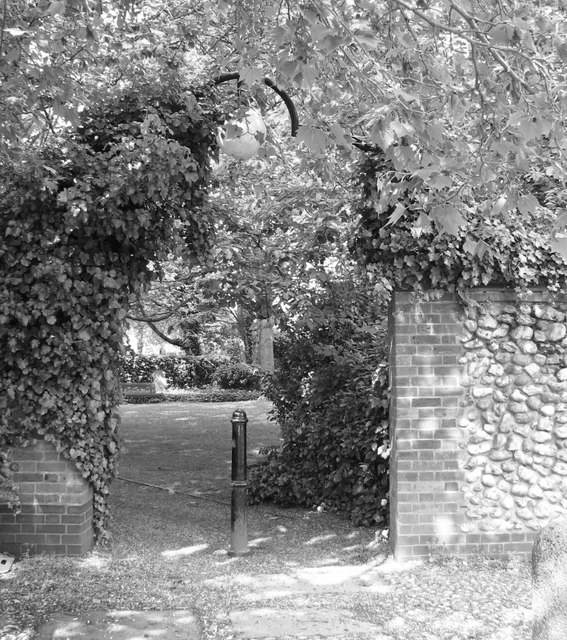
Image: © Evelyn Simak Taken: 25 May 2018
This location is well hidden although it is immediately adjacent to the road. The Norwich photographer and historian George Plunkett → http://www.georgeplunkett.co.uk/ informs that: “This rather secluded corner adjacent to the Adam and Eve public house was the location of the Meeting House or Tabernacle, a plain little red-brick building with pantiled roof and a double row of sash windows, opened by Mr Whitefield on 14 April 1753. Stanley Wearing in 'Georgian Norwich and its Builders' considered this to have been the first building in Norwich with which the locally famous architect Thomas Ivory was known to be connected. Since arriving in Norwich in 1750, the Reverend James Wheatley, a Calvinistic Methodist, had been preaching in the city at various places including a Tabernacle set up in a house on Scoles Green. Unfortunately his ideas were not generally well received and frequent riotous scenes occurred, resulting in his molestation to such an extent that on more than one occasion 'the poor creature was half dead, not able to walk alone, and in a most terrible condition', to quote one eye-witness. Nevertheless he was undeterred and was eventually able to purchase land for the building of the Meeting House, together with an adjoining three-storeyed dwelling house.” According to George Plunkett who had seen inside, “the Tabernacle was furnished with handsome mahogany seating and a beautiful pulpit”. In 1775, the building was sold to the Countess of Huntingdon who set up a trust to appoint ministers "whose preaching and sentiments (were) according to the articles and homilies of the Church of England". Disused by the 1930s, it was then acquired by the Eastern Gas Board, whose works adjoined to the north, and was pulled down early in 1953, the year of its bicentenary. An inscribed stone > https://www.geograph.org.uk/photo/5788894 situated in a rather dark niche immediately to the left of the entrance (now difficult to read) records the site's history.
Images are licensed for reuse under creativecommons.org/licenses/by-sa/2.0
Image Location

Latitude
52.633835
Longitude
1.302594