
Fireplace, Seaton Delaval Hall
Introduction
The photograph on this page of Fireplace, Seaton Delaval Hall by Andrew Curtis as part of the Geograph project.
The Geograph project started in 2005 with the aim of publishing, organising and preserving representative images for every square kilometre of Great Britain, Ireland and the Isle of Man.

There are currently over 7.5m images from over 14,400 individuals and you can help contribute to the project by visiting https://www.geograph.org.uk
Fireplace, Seaton Delaval Hall
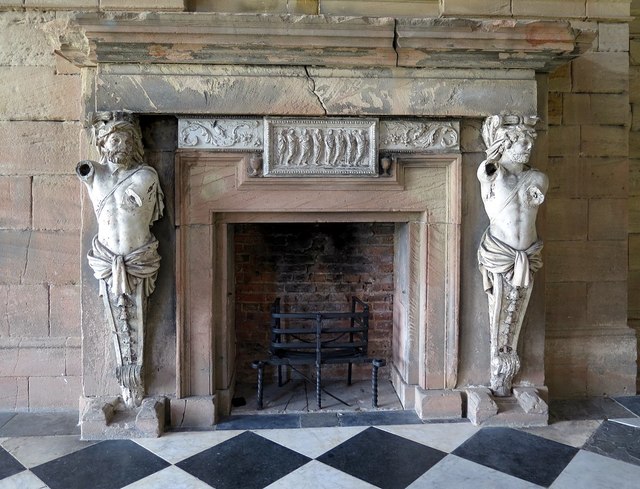
Image: © Andrew Curtis Taken: 16 Jul 2016
The stone fireplaces on the east and west sides of the great hall are supported by telamons (figures used as columns, the male equivalent of caryatids). The hall is paved with black and white marble. The size of the fireplaces was clearly inadequate to warm the huge, high space of the draughty north-facing hall. It was a jackdaw nest in a chimney which is believed to have been the cause of a blaze in 1822 which gutted the central block of Seaton Delaval Hall. At dusk on January 3, 1822, sailors off the Whitley Bay coast noticed that the sunset seemed unusually brilliant. It was the Seaton Delaval Hall fire. A newspaper report read: “Every endeavour to preserve the body of the building was unavailing; nothing but the bare walls being left standing. The fire is generally supposed to have originated in a chimney which had been rendered foul by birds having built their nests in it, and that hence the fire was communicated to a rafter fixed to the chimney.” The Central Hall, with its fire-damaged statues, has been a shell ever since. During repair and restoration work on the Great Hall in 2014, around 20 new nests, containing 30 jackdaw chicks, were found delaying work until they had fledged. The chimneys are now capped. http://www.chroniclelive.co.uk/news/north-east-news/jackdaws-leave-seaton-delaval-hall-7253968
Images are licensed for reuse under creativecommons.org/licenses/by-sa/2.0
Image Location

Latitude
55.082265
Longitude
-1.496518