
Headstone to Harry John READ, Railwayman
Introduction
The photograph on this page of Headstone to Harry John READ, Railwayman by Adrian S Pye as part of the Geograph project.
The Geograph project started in 2005 with the aim of publishing, organising and preserving representative images for every square kilometre of Great Britain, Ireland and the Isle of Man.

There are currently over 7.5m images from over 14,400 individuals and you can help contribute to the project by visiting https://www.geograph.org.uk
Headstone to Harry John READ, Railwayman
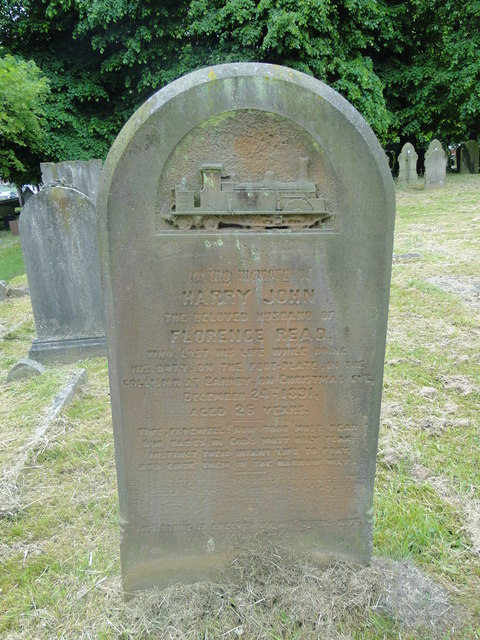
Image: © Adrian S Pye Taken: 17 Jun 2016
The writing on the headstone is eroding badly, it reads: In loving Memory of Harry John the beloved husband of Florence Read who lost his life while doing his duty on the footplate, in the collision at Barnby, on Christmas Eve, December 24th 1891. Aged 26 years. Wife, farewell now thou must rear Our babes in God's most holy fear Instruct their infant lips to pray And guide them in the narrow way. This stone is erected by his loving wife. "One of the most alarming and at the same time disastrous railway accidents with which this district has been visited for years, and which in some of its features recalls not a few terrible incidents ... took place at Barnby siding on Christmas Eve, Dec .24th (1891), and caused the utmost consternation amidst the inhabitants of Lowestoft and the neighbourhood generally, and ... Mist from the nearby marshes had obscured all vision. The down train from London was late arriving. The up train from Lowestoft left the siding at Barnby, proceeding onto the single track, and “... the Lowestoft train dashed into the other with such force as to deal out death and disaster in every direction, and by which three of our fellow creatures ... were suddenly deprived of their existence. ... Being a festive season, in the cottages at Barnby the villagers were lingering over the 'cup that cheers but not inebriates'... At the local pub, too, there was a considerable number of visitors at the time, and these hurried with all possible speed to the place ... Foremost amongst these was Mr Amos Beamish, a man of almost gigantic strength, which he turned to such good account as to make one believe it was specially increased for the occasion. Those present who witnessed his exertions and were undoubtedly stimulated by them, speak in the highest possible manner of the service he rendered. It seems his wife had been visiting a sick relative, and had nearly reached her home, when she-heard the fearful collision of the two engines, and she rushed into the house telling her husband what had taken place and the heart-rending screams to which she had been compelled to listen. The brave fellow at once rushed out with an implement which lay at hand which he soon wielded with such effect as to be the means of rescuing numbers from their perilous position, and which might possibly have ended in their case also fatally. By this time fires, made with portions of the wreck had been kindled, and amidst the cruel fog, which had been the prime cause of the disaster, might be seen his massive form moving from place to place, here assisting one from a quantity of debris and again with his axe cutting away the woodwork of the wrecked carriages and releasing the sufferers who had been literally embedded in the wreck of the ill-fated train. Search was naturally initiated for any who might have been pitched out of the train as the fearful concussion occurred. In this, too, as well as with others, Mr Beamish was successful. Some were found in a dazed condition, severally perfectly helpless because of fractures, broken limbs, wounded scalps, benumbed frames and other sufferings, but eventually the full extent of the disaster was fairly well gauged, and when the medical men arrived and they had little to do but attend to their numerous patients.”
Images are licensed for reuse under creativecommons.org/licenses/by-sa/2.0
Image Location

Latitude
52.481814
Longitude
1.739139