
St Annes Public Hall
Introduction
The photograph on this page of St Annes Public Hall by Gerald England as part of the Geograph project.
The Geograph project started in 2005 with the aim of publishing, organising and preserving representative images for every square kilometre of Great Britain, Ireland and the Isle of Man.

There are currently over 7.5m images from over 14,400 individuals and you can help contribute to the project by visiting https://www.geograph.org.uk
St Annes Public Hall
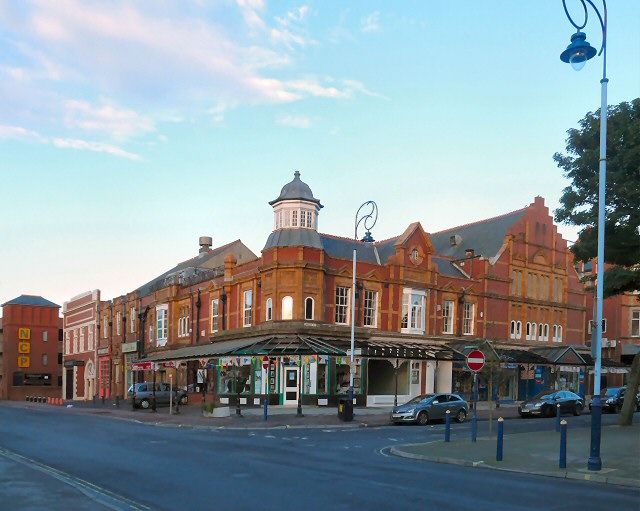
Image: © Gerald England Taken: 19 Aug 2012
A much-altered former Public Hall and Assembly Rooms of two and three storeys with Queen Anne features and elevations on St George's Road, Garden Street and St George's Lane, that opened in 1900 and was built to a design by John Dent Harker. By 1910 the building had become a cinema and alterations to the interior layout took place in 1925 after it was bought by the Blackpool Tower Company and became the Palace Cinema and Restaurant, complete with ballroom, restaurant, café, assembly room, Masonic room, billiard room and shops on the ground floor fronting Garden Street. At an unspecified date in the inter-war years part of the building fronting St George's Road was converted into a car showroom. Part of the building continued as a cinema until 1957 when it was sold to Lytham St Anne's freemasons. The former ballroom was converted into a Masonic Lodge Room and the former car showroom was converted into a furniture retailers. A large part of the ground floor was lowered and a covered market hall created. Externally a glass and iron canopy was added in the 1980s. http://www.pastscape.org.uk/hob.aspx?hob_id=1508119 The building was assessed for listing in 2009, but did not meet the criteria for addition to the list for the following reasons: It is a relatively late example of a Public Hall and Assembly Rooms in a seaside context. Whilst still contributing to the streetscape and the local Conservation Area, the building has undergone numerous external alterations that have reduced its architectural quality and authenticity. Wholesale internal changes have led to the loss of many of its original fixtures and fittings. The building's original internal layout is now difficult to recognise due to the many subsequent internal alterations.
Images are licensed for reuse under creativecommons.org/licenses/by-sa/2.0
Image Location

Latitude
53.752288
Longitude
-3.031826