
National Waterways Museum, Ellesmere Port - hydraulic pumping engine
Introduction
The photograph on this page of National Waterways Museum, Ellesmere Port - hydraulic pumping engine by Chris Allen as part of the Geograph project.
The Geograph project started in 2005 with the aim of publishing, organising and preserving representative images for every square kilometre of Great Britain, Ireland and the Isle of Man.

There are currently over 7.5m images from over 14,400 individuals and you can help contribute to the project by visiting https://www.geograph.org.uk
National Waterways Museum, Ellesmere Port - hydraulic pumping engine
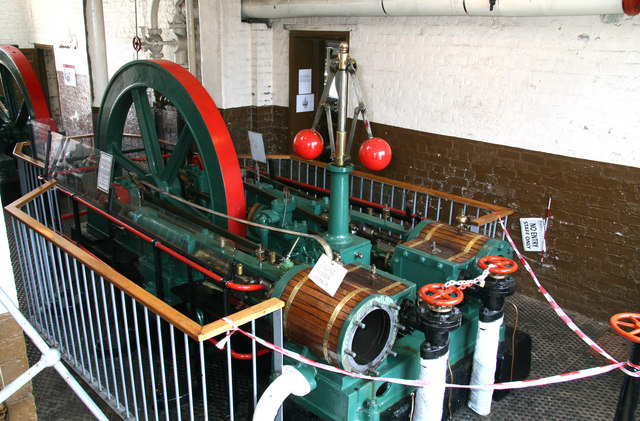
Image: © Chris Allen Taken: 24 Jun 2012
The docks made extensive use of hydraulic power with water at 750 psi piped from two pumping stations, each with two engines. Only the crankshafts and flywheels survive of the lower engines as the house was demolished. This is the upper engine house with one steamable engine and one largely dismantled engine (extreme left). The engines were built in 1873 by the renowned hydraulic engineering company - W G Armstrong of Elswick on the Tyne. It is a duplex cross-coupled engine good for 36.5 horsepower and pumping 56 gallons/minute. The hydraulic pumps are worked directly from the piston rods and the connecting rods are of pitchfork design and pass round the pumps. The cylinders have simple slide valves and there is a basic Watt type governor. The nearest cylinder has its piston out for overhaul.
Images are licensed for reuse under creativecommons.org/licenses/by-sa/2.0
Image Location

Latitude
53.287879
Longitude
-2.892941