
The 'Dover Engine'
Introduction
The photograph on this page of The 'Dover Engine' by Ashley Dace as part of the Geograph project.
The Geograph project started in 2005 with the aim of publishing, organising and preserving representative images for every square kilometre of Great Britain, Ireland and the Isle of Man.

There are currently over 7.5m images from over 14,400 individuals and you can help contribute to the project by visiting https://www.geograph.org.uk
The 'Dover Engine'
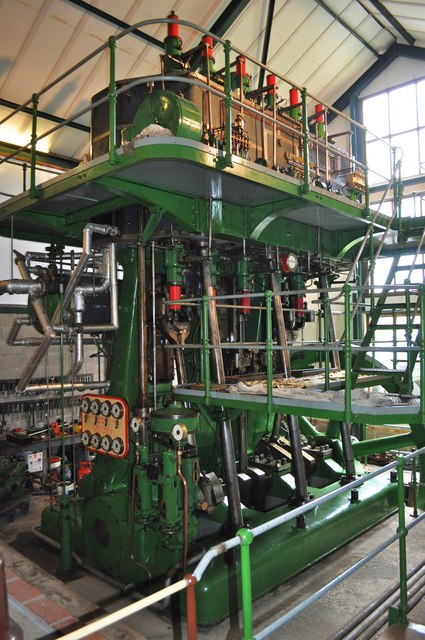
Image: © Ashley Dace Taken: 1 Aug 2010
Worthington Simpson No 5056 was built in 1937 with sister engine No 5055. However, this engine laid boxed up at Worthington Simpson's works in Newark during the war years. Even though war in Europe ended in 1945 it wasn't until 1954 that 5056 was unboxed and commissioned in service. Joining 5055 (working from 1939) at the Connaught Road Pumping Station, Dover. The high labour costs associated with the running of the engines meant that despite being virtually unworn, the engines commercial lives were over in the early 1970's. They were the last reciprocating waterworks steam pumping engines of any notable size to be erected for public waterworks service in the UK, one destined for preservation plans were drawn to remove some 85 tons of engine. Eventually taking about thirty lorry loads to get it to Forncett. Its design is of an inverted triple expansion type having three cylinders, 14 inch, 26 inch and 42 inch diameter by 36 inch stroke (although it possible the actual cylinder diameters are 14,24 and 36inchs). High pressure steam at 185 pounds per square inch was introduced through piston drop valves driven by a camshaft along the cylinder fronts first to the high pressure cylinder, then as it exhausted from here through a steam jacketed re heater it went to the intermediate pressure cylinder. The steam then went through the re heater again before reaching the low pressure cylinder. When exhausted from there, the steam was led to a condenser where the atmospheric pressure increased the efficiency of the engine. See the engine in situ Image] Designed to develop 147 horse power at 24 - 25 rpm this was by no means the largest UK pumping engine. If running at 25 rpm it could deliver 96,000 gallons of water each hour against a total head of 420 feet.
Images are licensed for reuse under creativecommons.org/licenses/by-sa/2.0
Image Location

Latitude
52.503977
Longitude
1.190855